BELLBIRD
The Bellbird of Australia (Bell Miner)
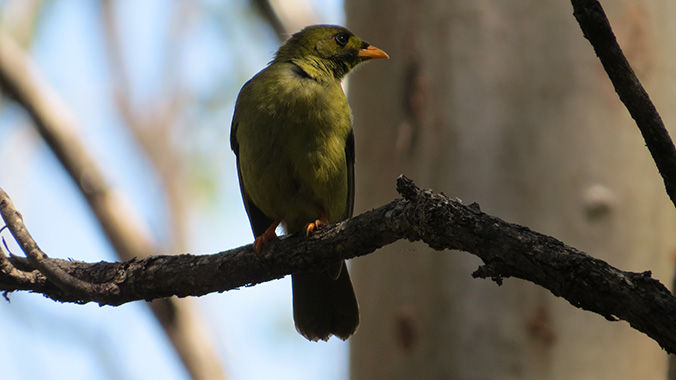
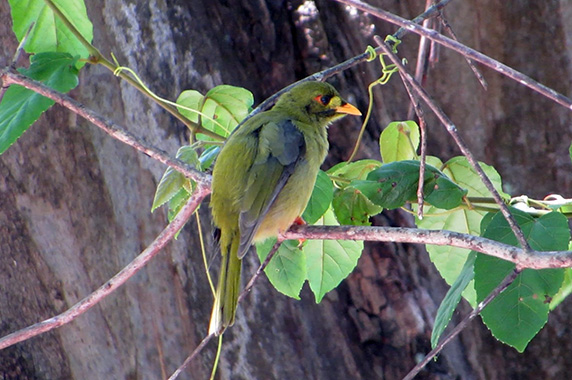
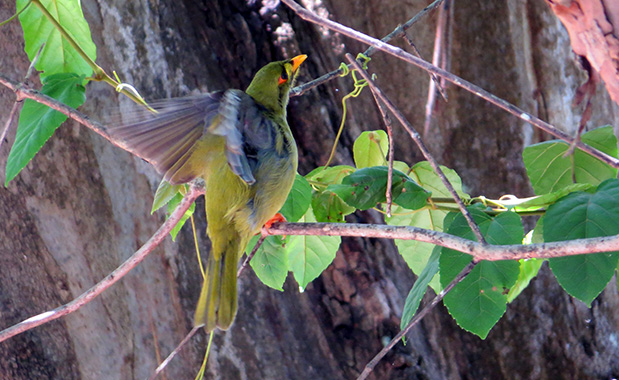
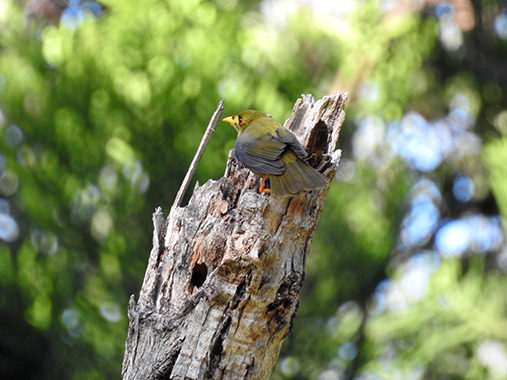
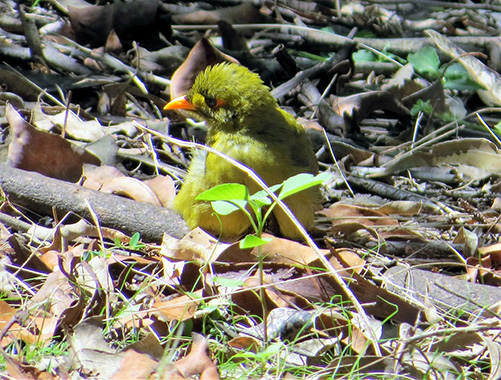
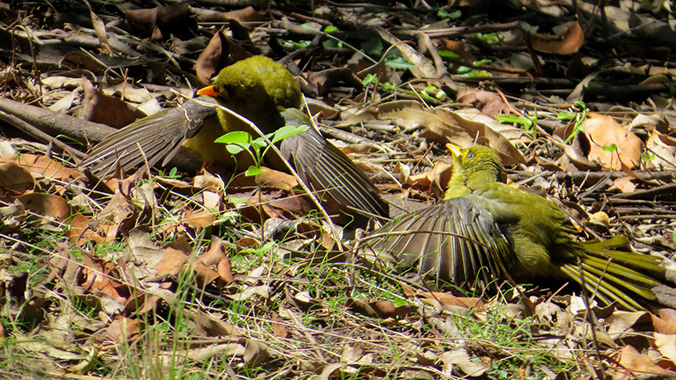
When people in Australia talk about a “bellbird”, they are usually referring to the Bell Miner (Manorina melanophrys) – a small, olive-green honeyeater with a voice that sounds like a tiny chiming bell. Its call can fill an entire valley with bright, metallic notes.
1. Who is the “Bellbird”?
Common & scientific name
- Common name: Bell Miner
- Also called: Bellbird (especially in older literature and poetry)
- Scientific name:
Manorina melanophrys - Family: Honeyeaters (
Meliphagidae)
General appearance
Imagine a small, lively bird slipping through a tangle of gum leaves:
- Size: Around 17–18 cm long, fairly small.
- Colour: Olive‑green body that blends well into eucalypt foliage.
- Face: Distinct black patch around the eye.
- Bill & bare skin: Bright yellow bill and yellow skin around the eye.
- Sexes: Males and females look very similar, though males are usually a little larger.
The famous “bell” call
The sound of a Bell Miner colony is unmistakable:
- A clear, repeated “tink… tink… tink” or “tink-tink-tink”, very much like a tiny bell.
- Calls often overlap from many birds, making a continuous, chiming sound.
- Colonies can be heard hundreds of metres away, especially in still morning or evening air.
Habitat and Distribution
Bell Miners are native to eastern Australia.
Where they live
- Range: From south‑eastern Queensland, along the New South Wales coast and ranges, into eastern Victoria.
- Preferred habitat:
- Wet and dry eucalypt forests, often with dense understorey.
- Frequently associated with riparian zones (along creeks and rivers).
- Often found in areas with thick regrowth, shrubby layers, and patches of dense foliage.
These birds are quite sedentary; colonies tend to stay in the same general area year after year, as long as conditions remain suitable.
Social Life: Colonies and Cooperative Behaviour
Bell Miners are highly social and live in cooperative colonies.
Colony structure
- A colony can contain dozens to over a hundred birds.
- Birds form small social units within the colony, like “neighbourhoods”.
- Many individuals help to raise young that are not their own – cooperative breeding.
Cooperative breeding
- Usually, one pair are the main breeders.
- Other birds, often related, act as helpers:
- Assist with feeding the chicks.
- Defend the territory from other bird species.
- This cooperation means colonies can be very effective at controlling who uses their patch of forest.
Diet and the “Bell Miner Associated Dieback” Story
Bell Miners feed primarily on insects and other invertebrates, and will also take some nectar.
Psyllids and “lerps”
A key part of their diet is:
- Psyllids – tiny sap-sucking insects that live on eucalyptus leaves.
- Psyllids produce sugary coverings called lerps, which look like small white or pale brown crystalline scales stuck to the leaves.
Bell Miners:
- Carefully eat the lerp covering and often leave the insect alive.
- This allows the psyllid to rebuild its sugary shelter, providing the birds with a renewable food source.
Bell Miner Associated Dieback (BMAD)
This feeding behaviour has unintended consequences for the forest:
Psyllid explosion
Because the psyllids are not killed, their numbers can grow dramatically.Tree stress and dieback
Heavy psyllid infestations weaken eucalyptus trees, causing:- Thinning of the canopy.
- Branch dieback.
- In severe cases, tree death.
Bell Miner’s role
- Bell Miners aggressively chase away many other insect‑eating birds that would normally keep psyllid numbers in check.
- This leads to a condition known as Bell Miner Associated Dieback, especially in disturbed or modified forests (for example, where understorey has changed due to logging, fire regimes, or weeds).
So, although Bell Miners are a natural part of the ecosystem, certain human‑driven changes to the landscape can create conditions where:
- Bell Miner colonies expand.
- Psyllids increase.
- Eucalypts suffer.
This is an important conservation and forest management issue in parts of eastern Australia.
Breeding and Nesting
Breeding season
- Mostly spring to early summer, though timing varies with climate and local conditions.
Nest
- A small cup-shaped nest.
- Made from grasses, fine twigs, and plant fibres.
- Usually placed in:
- Dense shrubs or low branches.
- Well hidden among leaves near the inner parts of the tree.
Eggs and chicks
- Clutch size: Usually 2–3 eggs.
- Eggs are incubated by the breeding female, while the male and helpers play a strong role in feeding the chicks once they hatch.
- The young are fed mainly on soft-bodied insects and other invertebrates.
Cultural and Indigenous Connections
Bell Miners are part of the deep cultural landscape of eastern Australia, where Aboriginal and Torres Strait Islander peoples have long observed, named, and understood birds as part of living Country.
Note: Australia is home to hundreds of First Nations, each with its own languages and knowledge systems. Names, stories, and meanings associated with Bell Miners vary between Nations and regions.
Traditional knowledge and observation
First Nations peoples have:
- Long recognised the distinctive bell-like call and used it as a sound marker of place – a sign of certain types of eucalypt forest or wetter gullies.
- Read bird calls as weather and seasonal indicators. For example:
- The prominence or absence of certain calls can signal changes in rainfall, flowering of certain trees, or the presence of particular insects.
- Observed the relationship between Bell Miners, psyllids and eucalypt condition well before Western science described BMAD:
- In some areas, people noted that where bellbirds called constantly, the trees often looked stressed or sick.
Because each language group has its own words, there is no single “Aboriginal name” for the Bell Miner. In some regions, the bird’s name imitates its “tink” call, similar to how English speakers named it “bellbird”.
Bellbirds in story and song
In many Aboriginal cultures:
- Birds form part of songlines, Dreaming stories, and totems.
- Particular birds can be:
- Totemic animals, linked to family, clan, or Country.
- Teachers in story, showing how to live respectfully on Country, or what happens when balance is lost.
While specific sacred narratives are often not shared publicly, we can say in general:
- A bird like the Bell Miner, which shapes the forest around it, fits into the broader understanding that every being on Country has a role.
- Stories may emphasise listening carefully to bird calls as a way of staying in tune with Country.
If you are interested in detailed Indigenous stories, names, or songlines for Bell Miners in a specific area, it is best to:
- Look for resources produced with or by local Traditional Owners, or
- Visit local cultural centres or Indigenous ranger groups, who can share what is appropriate to make public.
In Literature and Modern Culture
The sound of “bellbirds” has also inspired many non‑Indigenous writers and artists. Most famously:
- Henry Kendall’s poem “Bell-Birds” (1869) describes:
- The chiming calls in forested gullies.
- A sense of peace and timelessness in the bellbird-filled valleys of New South Wales.
While Kendall’s poem is romantic and not scientific, it reflects how deeply this small bird’s call has become part of the cultural imagination of eastern Australian forests.
Conservation and Management
Conservation status
- Currently not listed as threatened; in some places Bell Miner numbers have actually increased.
- However, their association with forest dieback is a concern.
Why management matters
- Bell Miners themselves are native and important, but:
- When forests are heavily disturbed or simplified,
- Dense understorey and changes in structure can favour large colonies,
- Leading to escalating psyllid infestations and eucalypt decline.
Approaches used in some regions
- Restoring more natural forest structure, including:
- Reducing dense weedy understorey.
- Encouraging a mix of plant species and age classes.
- Allowing or encouraging the return of other insect‑eating bird species to balance psyllid numbers.
- Managing fire regimes and logging to minimise conditions that favour unnaturally large Bell Miner colonies.
This fits a broader conservation lesson: rather than blaming a single species, we look at the whole ecosystem and aim to restore balance.
Listening for Bell Miners
If you ever walk through eucalypt forest in eastern Australia:
- Pause by a shaded gully or creek.
- Listen for a bright, metallic “tink-tink-tink” from somewhere high in the foliage.
- If you look carefully into the green canopy, you may glimpse a small, olive bird with a yellow bill, slipping between leaves.
You will not just be hearing a bird; you will be listening to:
- A social community working together.
- An insect hunter that can shape the health of whole groves of trees.
- A voice that has been recognised, named, and interpreted by First Nations peoples for countless generations.
Bell Miner Photo Gallery