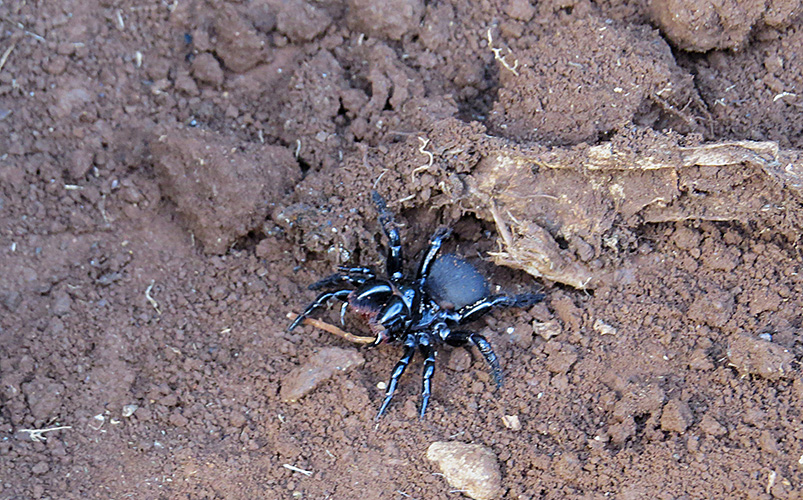
Mouse spider
Australian Mouse Spiders
Powerful burrowers of the bush
On a warm evening after rain, the soil at the edge of a bush track may shift slightly. From a silk‑lined burrow, a stocky spider waits — glossy, low to the ground, and rarely seen. This is the Australian mouse spider, one of the country’s most robust and misunderstood spiders.
Mouse spiders belong to the genus Missulena and are part of Australia’s unique group of mygalomorph spiders, relatives of funnel‑webs and trapdoor spiders.
Where Mouse Spiders Are Found
Mouse spiders occur across mainland Australia, including:
- Western Australia
- South Australia
- Victoria
- New South Wales
- Queensland
They are most common in:
- Open bushland
- Grasslands
- Heathlands
- Urban gardens with undisturbed soil
They live almost entirely underground, emerging mainly after rain.
Appearance and Identification
Mouse spiders are unmistakably solid in appearance.
Key features:
- Thick, muscular legs
- Large, powerful fangs
- Smooth, glossy bodies
- Females: usually dark brown or black
- Males: often have bright red or orange jaws (chelicerae)
Despite the name, they are not named after mice, but possibly for their mouse‑like burrows or stout shape.
Species Diversity
There are over 40 known species of mouse spiders in Australia.
Well-known examples include:
- Eastern mouse spider (Missulena bradleyi)
- Red‑headed mouse spider (Missulena occatoria)
Many species are still poorly studied due to their secretive lifestyle.
Burrows and Daily Life
Mouse spiders are expert diggers.
Their burrows:
- Are silk-lined
- Often have a hinged trapdoor or open entrance
- Can be surprisingly deep
- Provide protection from heat, predators and drought
They wait just inside the entrance, sensing vibrations through the ground.
What Mouse Spiders Eat
Mouse spiders are ambush predators.
Their prey includes:
- Insects
- Beetles
- Other spiders
- Small invertebrates
When prey passes near the burrow, the spider lunges forward with speed, dragging it underground.
Breeding Behaviour
Breeding usually occurs after heavy rain.
- Males leave their burrows to search for females
- During this time, males may wander into yards, houses or swimming pools
- Females lay eggs inside the burrow and guard them
Males typically die shortly after mating.
Longevity
Mouse spiders are long‑lived:
- Females: up to 10 years or more
- Males: usually shorter-lived, dying after mating
Their slow growth reflects their underground lifestyle.
Venom and Human Safety
Mouse spiders are highly venomous, and their venom is similar in strength to that of funnel‑web spiders.
Important facts:
- Bites are very rare
- Serious envenomation is uncommon
- The funnel‑web antivenom is effective for mouse spider bites
- Most bites occur when spiders are handled or trapped
Important safety message:
Mouse spiders should never be handled. Any suspected bite requires immediate medical attention.
Indigenous Knowledge and Cultural Context
For Aboriginal Australians, burrowing animals were important indicators of soil health and seasonal change.
- Spiders living underground were observed as part of Country’s hidden life
- Their emergence after rain signalled shifts in weather and insect activity
- Respect and avoidance, rather than fear, guided interactions
This deep observational knowledge helped people live safely alongside potentially dangerous species.
Interesting Facts About Mouse Spiders
- Females may remain in the same burrow for most of their lives
- Some males have bright red jaws used in mating displays
- Rain triggers surface activity
- They are ancient spiders with lineage dating back millions of years
- Their venom has been studied for medical research
Why Mouse Spiders Matter
Mouse spiders play a valuable ecological role:
- They help control insect populations
- Their burrows improve soil aeration
- They are part of Australia’s unique evolutionary history
Understanding mouse spiders replaces fear with respect. These powerful, secretive animals are not aggressive — they are simply highly specialised survivors of Australia’s ancient landscapes.
Photo Gallery