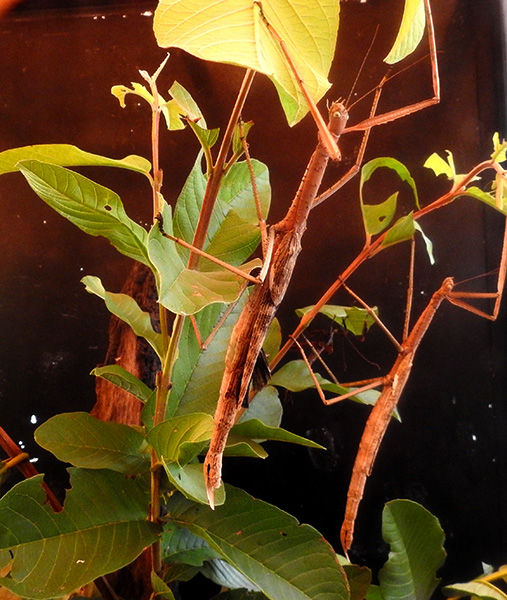
Wuelfing's Stick Insect
Acrophylla wuelfingi
Wülfing’s Stick Insect
High among the leaves of Australia’s eastern forests lives a remarkable insect that seems to belong more to the plant world than the animal one. Wülfing’s Stick Insect is a master of disguise, spending its life almost entirely among branches where shape, colour, and stillness offer the best protection.
A Forest Dweller Perfectly Disguised
Acrophylla wuelfingi is a large stick insect, best known for its flattened body and leaf‑like appearance rather than a thin, twig‑shaped form.
Adult males grow to a length of 90-150 millimeters while adult females grow to a length of 180–230 millimeters, if not including the lengths of their arms outstretched.
Both sexes develop wings when fully mature.
Due to their much larger size and heavier bodies, females are unable to fly.
Males are smaller and slimmer, with fully developed wings however they only fly for short distances. Instead, they mostly use their wings to startle predators.
When at rest, both sexes rely on stillness and camouflage, blending seamlessly into leaves and branches.
Habitat and Distribution
Wülfing’s Stick Insect is found only in far‑north Queensland, along the northern part of Australia’s east coast.
It lives in a variety of well‑vegetated habitats, including:
- Tropical and subtropical rainforests
- Eucalypt bushland
- She‑oak woodlands, particularly those dominated by Allocasuarina species
- Forest edges and regrowth areas
- Suburban gardens with suitable native vegetation
This species is closely tied to healthy plant communities and is most often found where native trees and shrubs provide food and shelter.
Longevity and Life Span
This species has a slow and extended life cycle compared with many insects.
Adult females may live for up to a year, while males usually have shorter adult lives.
From egg to natural death, an individual may remain part of the ecosystem for over twelve months.
Breeding and Reproduction
Breeding typically occurs during the warmer months when food plants are abundant.
Males use flight to locate females high in the canopy.
After mating, females lay eggs individually, dropping them to the forest floor.
The eggs resemble small seeds, helping them blend into leaf litter and avoid detection.
Once hatched, the tiny nymphs instinctively climb upwards into vegetation to begin feeding.
Behaviour and Defence
Wülfing’s Stick Insect is nocturnal, feeding at night and remaining motionless during the day.
When disturbed, it may sway gently to imitate leaves moving in the breeze. Females can spread their wings slightly to appear larger, while both sexes may release a defensive spray with a sharp scent, discouraging predators without causing harm.
These quiet defences reduce the need for escape or confrontation.
Indigenous Connections
Although detailed records for Acrophylla wuelfingi vary between regions, insects such as stick insects are recognised by many Aboriginal and Torres Strait Islander peoples as important parts of Country.
In Indigenous ecological knowledge, insects are often observed as indicators of seasonal change and environmental health. Stick insects, with their close relationship to trees and leaves, reflect the deep connections between land, plants, animals, and people.
How You Can Help Protect Them
While Acrophylla wuelfingi is not currently listed as threatened, it relies on intact native forests.
You can help by protecting native vegetation, planting indigenous trees and shrubs, avoiding pesticide use, allowing leaf litter to remain on the ground where eggs may rest, and observing stick insects without handling them.
Small, thoughtful actions help preserve the quiet habitats these insects depend on.
A Quiet Presence in the Canopy
Wülfing’s Stick Insect reminds us that some of Australia’s most remarkable animals are those we rarely notice. By blending into leaves and moving through the forest unnoticed, Acrophylla wuelfingi plays its part in the living fabric of Australian ecosystems, a quiet presence worth protecting and understanding.
Photo Gallery