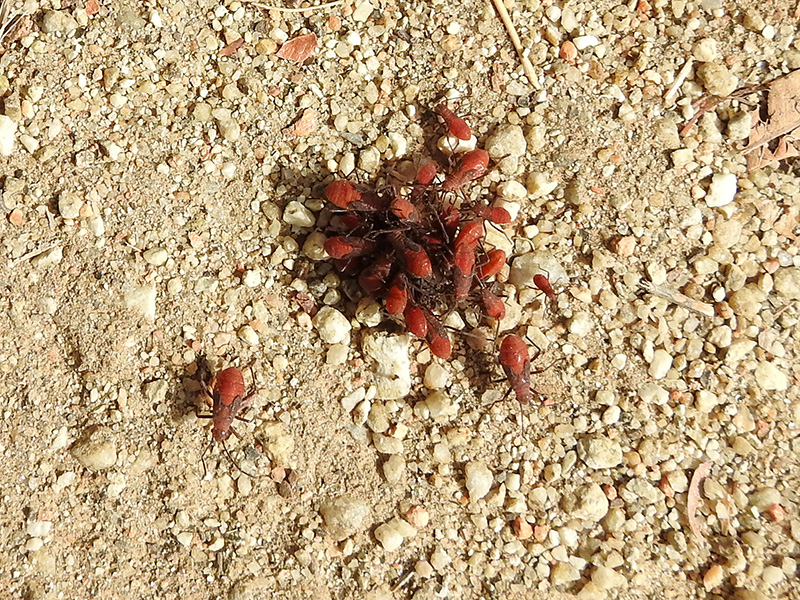
Soapberry Bugs
Soapberry Bugs in Australia
On warm Australian days, you might notice clusters of bright red and black bugs gathered on seed pods, leaf litter, or even garden plants. At first glance they look dramatic — almost warning-coloured — but these insects are not pests or dangers. They are soapberry bugs, native insects that tell a fascinating story of adaptation, plants, and change.
What Is a Soapberry Bug?
In Australia, the name soapberry bug most commonly refers to insects in the genus Leptocoris, particularly Leptocoris tagalicus and Leptocoris mitellatus. They belong to:
- Order: Hemiptera (true bugs)
- Family:
- (scentless plant bugs)
Soapberry bugs are invertebrates and true bugs, meaning they have piercing–sucking mouthparts rather than jaws.
They are called soapberry bugs because they feed mainly on the seeds of plants in the soapberry family (Sapindaceae) (sown.com.au).
Appearance and Identification
Soapberry bugs are easy to recognise:
- Body length around 12–15 mm
- Bright red or orange-red eyes
- Red and black body markings
- Long, narrow beak (proboscis) used to pierce seeds
- Nymphs resemble adults but lack fully developed wings
They are often seen in large groups, especially during warm weather or when seed supplies are abundant (brisbaneinsects.com).
Where Are Soapberry Bugs Found in Australia?
Soapberry bugs are native and widespread, occurring across:
- Queensland
- New South Wales
- South Australia
- Northern Territory
- Western Australia
Different species and subspecies occupy different habitats:
- Coastal and eastern regions – often larger-bodied forms
- Inland, savanna and semi‑arid regions – typically smaller-bodied forms
They live wherever suitable host plants grow, from rainforests and woodlands to urban gardens (pmc.ncbi.nlm.nih.gov).
What Do Soapberry Bugs Eat?
Soapberry bugs are seed feeders. Using their long beak, they:
- Pierce the hard outer wall of seeds or fruits
- Inject digestive enzymes
- Suck up the liquefied seed contents
Native host plants include:
- Alectryon species
- Atalaya hemiglauca
- Other native Sapindaceae
Introduced plants now used:
- Balloon vine (Cardiospermum grandiflorum)
- Lesser balloon vine (Cardiospermum halicacabum)
This shift to introduced plants has led to measurable physical changes, including longer beaks in some populations — a rare and well‑studied example of rapid evolution in Australia (pubmed.ncbi.nlm.nih.gov).
Life Cycle
Soapberry bugs undergo incomplete metamorphosis:
- Eggs laid near host plants
- Nymphs hatch and feed on seeds
- Several moults occur as the nymph grows
- Adult bugs emerge with wings
Nymphs and adults often feed together in dense groups, especially around fallen seed pods (jungledragon.com).
Are Soapberry Bugs Harmful?
To people:
No. Soapberry bugs:
- Do not bite or sting
- Do not carry disease
- Are harmless to humans
If crushed, they may release a mild odour, but they are not toxic (abc.net.au).
To plants:
They may cause:
- Minor cosmetic damage to seeds or fruit
- Occasional nuisance in gardens
They are not considered serious agricultural pests.
Population Swarms and “Bug Seasons”
In some years, soapberry bugs appear in huge numbers, particularly in South Australia and eastern states. These population booms are linked to:
- Warm temperatures
- Abundant seed production
- Dry conditions driving insects into towns and gardens
Such events are temporary, with numbers dropping as weather cools (abc.net.au).
Ecological Importance
Soapberry bugs play a quiet but important role:
- Regulate seed numbers of native plants
- Provide food for birds, reptiles and spiders
- Demonstrate how native insects respond to environmental change
Their ability to adapt to new host plants has made them a key species in evolutionary research.
A Living Lesson in Adaptation
Soapberry bugs remind us that evolution is not just something of the distant past. It is happening now, in Australian backyards, along riverbanks and beneath trees.
Small, bright and often overlooked, these insects show how closely life is tied to plants — and how quickly nature can respond when the environment changes.
Photo Gallery