WHITE-BROWED CRAKE
Poliolimnas cinereus
The Masked Forager: White-browed Crake
Appearance: The Bird with the Racing Stripes
The White-browed Crake is a small, compact wetland bird, measuring about 18 to 20 centimetres. It has a very distinctive “face mask” that makes it easy to identify if you catch a clear glimpse:
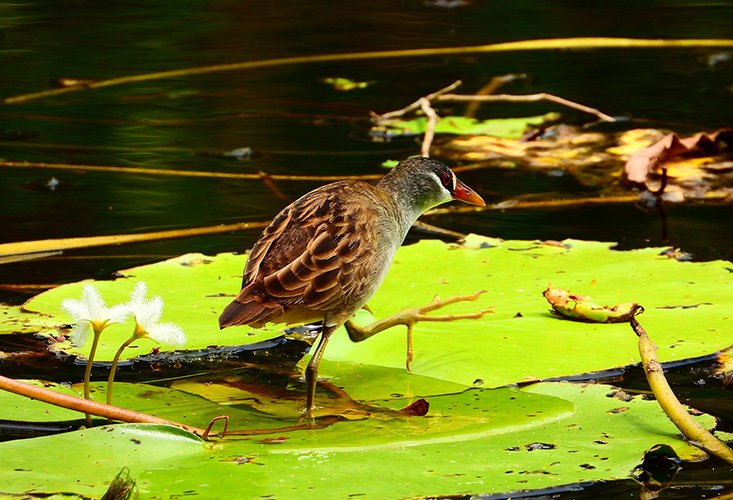
- The “Eyebrows”: Its name comes from the two bold white stripes on its face. One sits like a thick eyebrow above the eye, and the other runs from the base of the beak down to the ear, sandwiching a dark black “bandit mask” across the eye.
- The Eyes: They have striking, ruby-red eyes that stand out vividly against their grey and brown face.
- The Body: Their underparts are a clean, ashy grey, while their back and wings are a mottled olive-brown, providing perfect camouflage among dry reeds and muddy banks.
- The Bill and Legs: They have a short, yellowish bill (often with a red spot at the base) and long, sturdy olive-green legs with large feet, similar to the Jacana, for navigating floating plants.
Longevity: A Short but Busy Life
In the wild, small wetland birds like the White-browed Crake typically have a lifespan of about 3 to 5 years. Because they live in high-predation environments (where snakes, hawks, and large fish are always on the hunt), they focus on breeding quickly and often during the wet season.
Behavior: The “Chika-Chika” Ghost
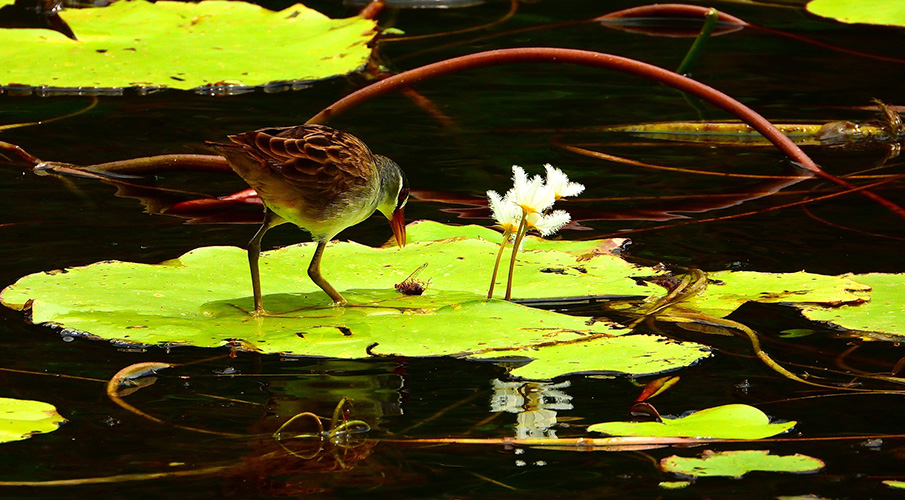
Unlike many other crakes that stay deep within the reeds, the White-browed Crake is often seen stepping out onto the lily pads, especially in the early morning or late afternoon.
- The Call:You will often hear thembefore you see them. Their call is a loud, rhythmic ‘chika-chika-chika’, which can erupt suddenly from a clump of vegetation.
- The Hiding Trick: When they feel threatened, they don’t always fly away. Instead, they are known to “submerge” themselves, sinking their bodies underwater so only their head and beak remain above the surface, blending in perfectly with the aquatic plants.
- Walking on Water: While they don’t have the “snowshoe” toes as long as a Jacana’s, they are still incredibly light on their feet, darting across the water lilies with a flick of their short, stubby tails.
Habitat and Distribution
The White-browed Crake is primarily a bird of the tropical north. You’ll find them commonly in the Kimberley, the Top End, and across Northern Queensland.
In South-East Queensland and New South Wales, seeing a White-browed Crake is a very special event! They are considered rare “vagrants” or occasional visitors this far south, usually appearing when northern wetlands dry out and they move south in search of permanent water.
Diet: Wetland Gleaners
They are opportunistic feeders. You’ll see them delicately “gleaning” (picking) food from the surface of lily pads and the water’s edge. Their diet includes:
- Small aquatic insects and larvae.
- Tiny molluscs and crustaceans.
- Seeds from wetland plants like water lilies and grasses.
Conservation: The Importance of Healthy Swamps
The White-browed Crake relies on “floating gardens.” Because they need dense, floating vegetation for both feeding and nesting (they build shallow, cup-shaped nests just above the water), they are very sensitive to habitat changes. Protecting our freshwater swamps from pollution and invasive weeds—which can choke out the native lilies they love—is vital for their survival.
Photo Gallery