Longicorn Beetle
Poinciana Longicorn Beetle: A Forest Giant
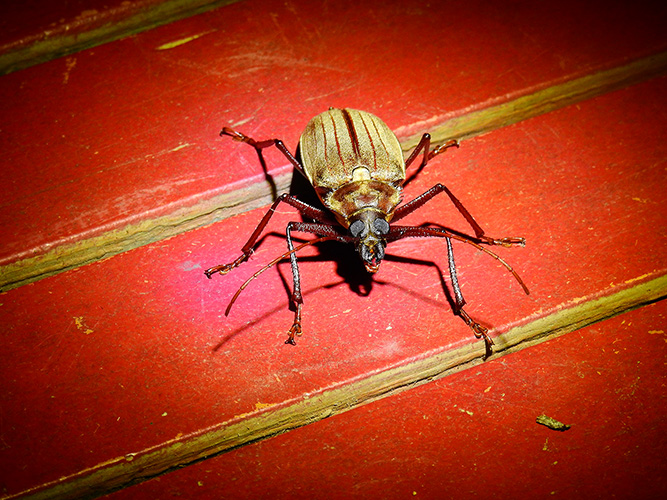
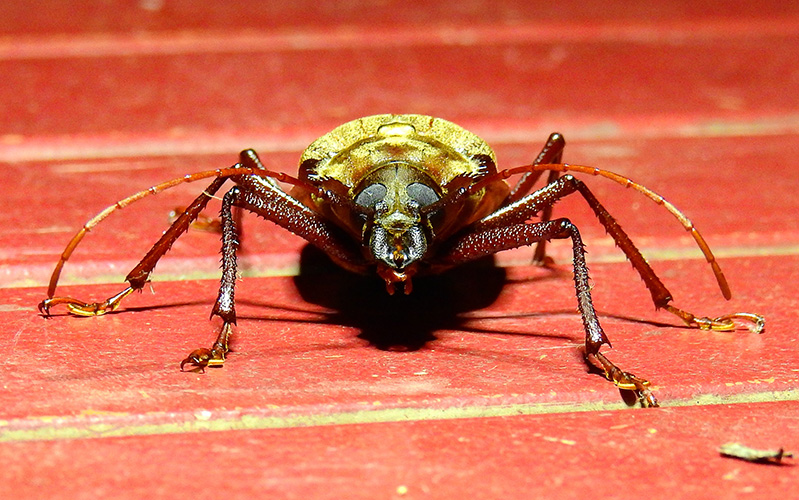
If you’re out and about on a warm summer night near the rainforests or open forests of eastern Australia, you might just encounter one of our most impressive insects. With antennae longer than its own body and a formidable-looking suit of armour, the Poinciana Longicorn Beetle (Agrianome spinicollis) is a true giant of the beetle world.
Found from Queensland down through New South Wales and out to Lord Howe Island, this beetle is a master of the night shift. While it might look a bit intimidating, it’s a fascinating piece of our natural puzzle.
A Closer Look
You won’t mistake this beetle for anything else. It’s a hefty creature, with adults growing up to a whopping 60 millimetres in length.
- The “Long Horns”: Its most striking feature is, of course, its antennae. These super-long feelers, which give the family its name (“longicorn”), can be even longer than the beetle’s entire body. They are sensitive instruments used for navigating the dark and finding a mate.
- Built for Toughness: It has tough, khaki-coloured wing cases covering its back. Its thorax (the section behind the head) is a deep reddish-brown and is edged with sharp, pointed spines, giving it a definite “don’t mess with me” vibe.
- A Warning Click: If you get too close or try to handle one, it has a surprising defence trick. By rubbing ridges on its head against its thorax, it can make a loud, startling “clicking” or squeaking sound. It’s a clear warning to back off! While they aren’t venomous, they have strong mandibles and can give a fierce nip if provoked, so it’s best to admire them from a respectful distance.
The Secret Life of a Wood-Borer
The adult beetles you see flying around lights in summer are just the final, brief chapter in a long life story. For most of its life—up to two to four years—this insect lives a hidden existence completely out of sight.
Its life begins as an egg laid in the bark of a tree. When it hatches, a tiny larva bores its way into the wood. This larva is a huge, creamy-white “witchetty grub” with powerful jaws but no legs. It spends years tunnelling through the heartwood of the tree, munching on cellulose and creating a labyrinth of galleries.
This hidden world inside a decaying log is a dark, damp ecosystem of its own, filled with fungi, moisture, and the scent of rotting timber. The larva is a vital part of the forest’s recycling crew, helping to break down dead wood and return nutrients to the soil. They are polyphagous, meaning they aren’t fussy eaters and will bore into a wide variety of hardwood trees, including native figs as well as introduced species like Poinciana, Pecan, and Bauhinia trees.
When it’s finally time to grow up, the larva creates a special chamber near the surface of the wood and pupates. It transforms into an adult, then chews its way out to meet the world.
Adults on the Wing
Adult Poinciana Longicorns emerge during the warm summer months, from December to February. They are creatures of the night, taking flight after dusk to find a mate and start the cycle all over again. You’ll often find them resting on tree trunks, blending in with the bark, or sometimes feeding on nectar and pollen from native flowers. Like many nocturnal insects, they are often attracted to house lights, which is how many people first discover them.
While their larvae can sometimes be a pest in pecan plantations or ornamental trees, in their natural forest habitat, they are a crucial part of the ecosystem’s life cycle of growth and decay.
Photo Gallery