Cairns Birdwing Butterfly
Cairns Birdwing Butterfly: Australia’s Rainforest Giant
Scientific Name: Ornithoptera euphorion Family: Papilionidae (Swallowtails) Region: North-Eastern Queensland (Mackay to Cooktown)
The Cairns Birdwing is not just an insect; it is an icon of the Australian Wet Tropics. As Australia’s largest endemic butterfly, with females boasting a wingspan of up to 15cm, it is a “bucket list” species for entomologists and nature enthusiasts alike.
Life Cycle & Lifespan: A Life in Four Acts
Like all butterflies, the Cairns Birdwing undergoes complete metamorphosis. However, unlike smaller species that might only fly for a few days, the Birdwing is a robust creature with a longer adult life.
The entire cycle from egg to the death of the adult takes approximately 10 to 14 weeks, depending on the temperature (warmer weather speeds up the process).
1. The Egg (duration: approx. 7-9 days)
The journey begins with a large, pale yellow egg, about the size of a pinhead (approx. 3mm), laid singly on the underside of a host vine leaf.
2. The Larva / Caterpillar (duration: approx. 4 weeks)
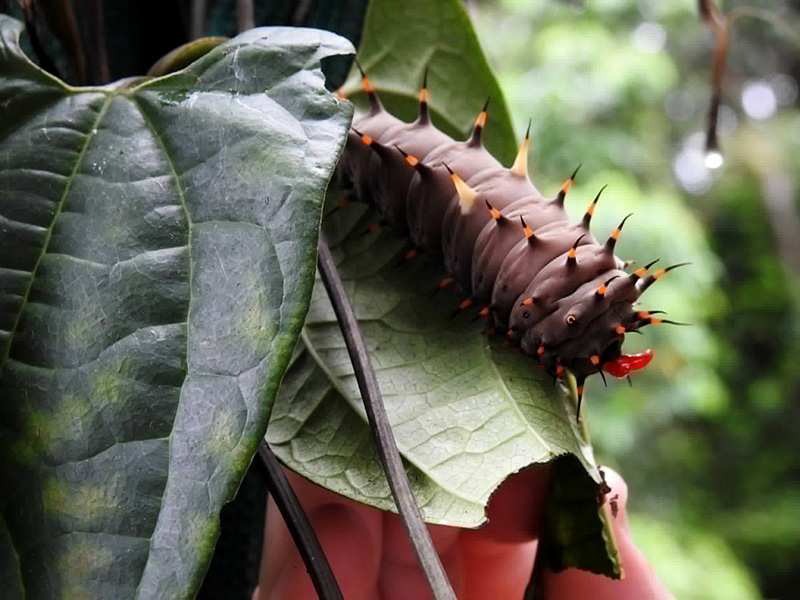
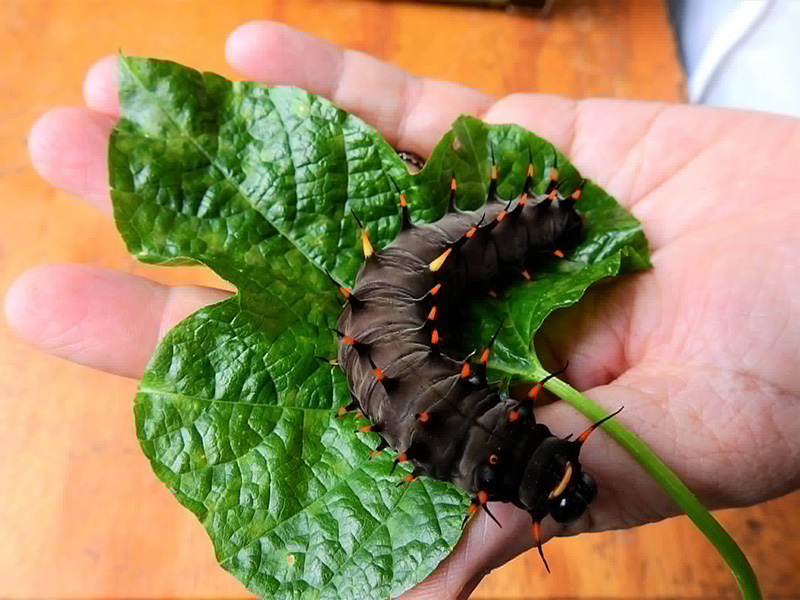
This is the main growth phase. The caterpillar is a “eating machine,” shedding its skin (moulting) five times as it grows.
- Scientific Note: The rate of growth is temperature-dependent. In the tropical heat of Cairns, this stage is faster than in cooler southern gardens.
3. The Pupa / Chrysalis (duration: approx. 4 weeks)
The caterpillar suspends itself and forms a chrysalis. Inside, the body is broken down at a cellular level and reorganised into the adult form.
4. The Adult Butterfly (duration: 4 to 5 weeks)
Once they emerge, the clock starts ticking on their final phase.
- Lifespan: Adult Cairns Birdwings typically live for 4 to 5 weeks in the wild.
- Sexual Difference: Females generally live slightly longer than males (sometimes up to 8 weeks in ideal conditions) to ensure they have ample time to disperse and lay all their eggs.
Educational Insight: Compare this to the Common Brown or smaller blues, which may only live for 2 weeks as adults. The Birdwing’s size and energy reserves allow for a longer flight period, which helps them travel further to find mates and rare host vines.
Identification and Morphology: A Study in Contrast
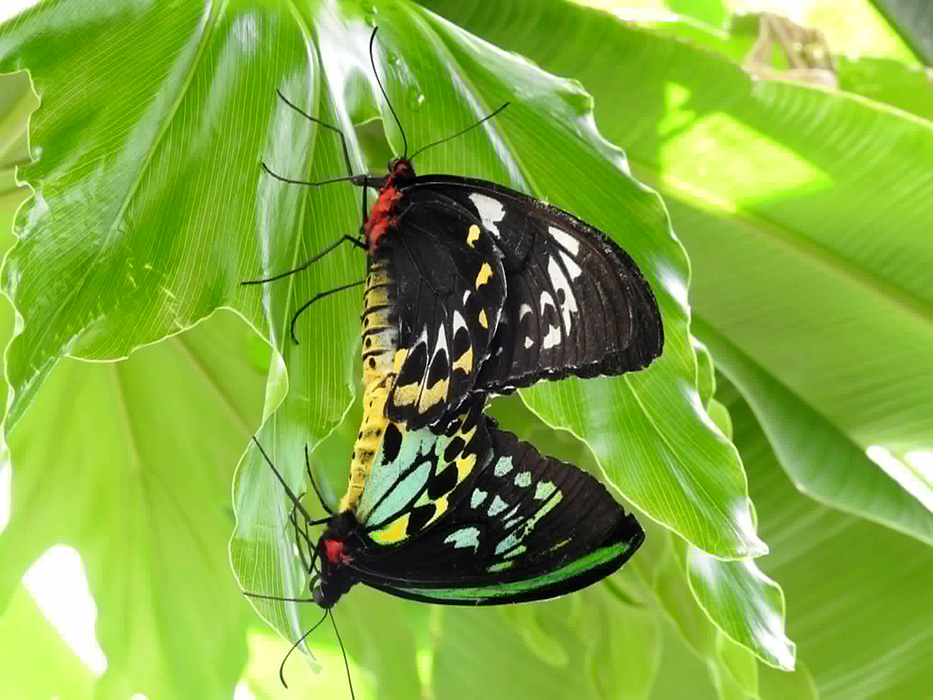
To understand the Cairns Birdwing, one must appreciate sexual dimorphism—where males and females look distinctly different.
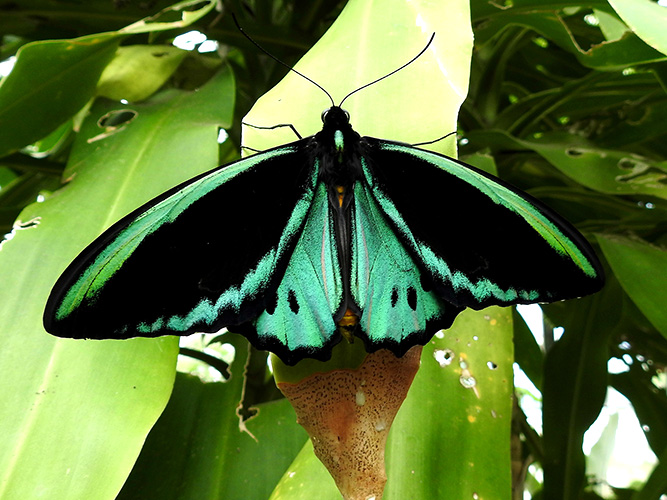
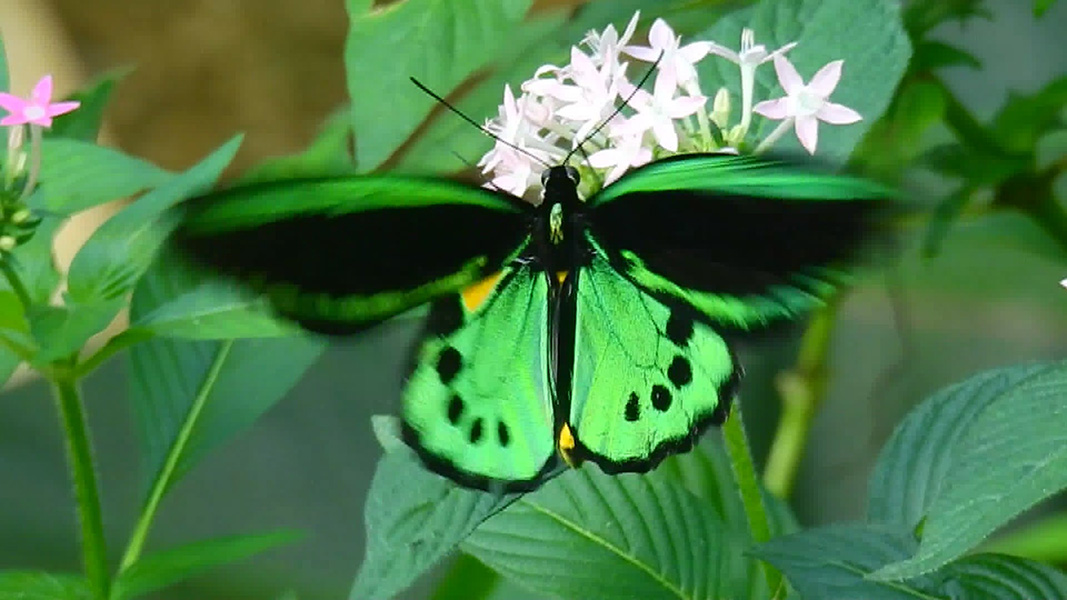
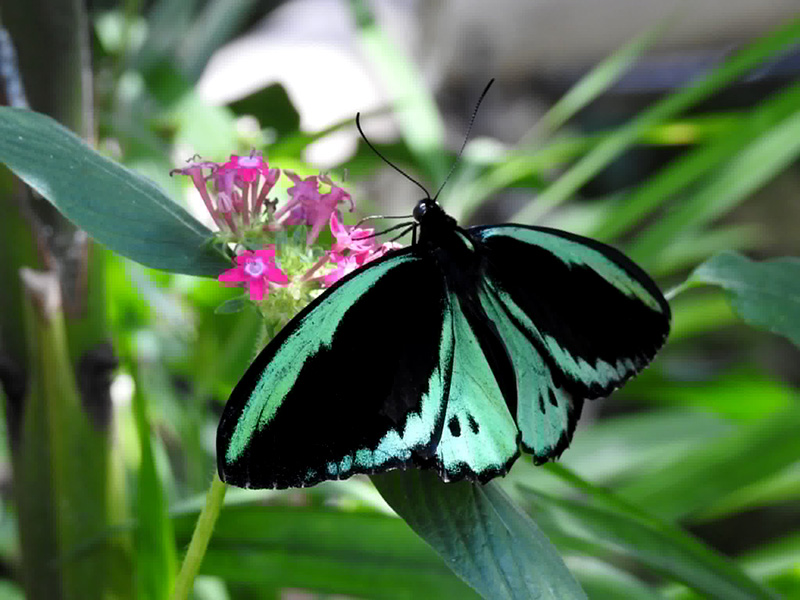
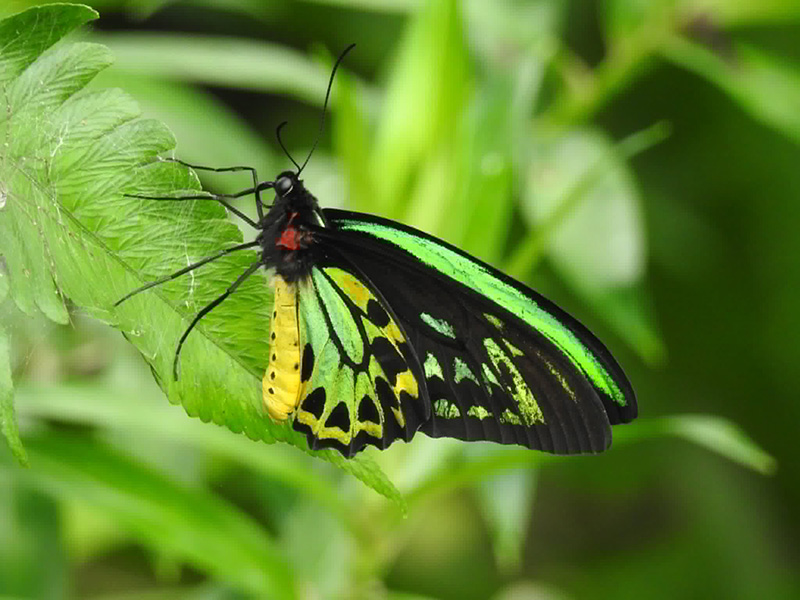
- The Male: Distinctly smaller but vibrant. His wings are a striking contrast of velvety black and electric emerald green, often with gold patches.
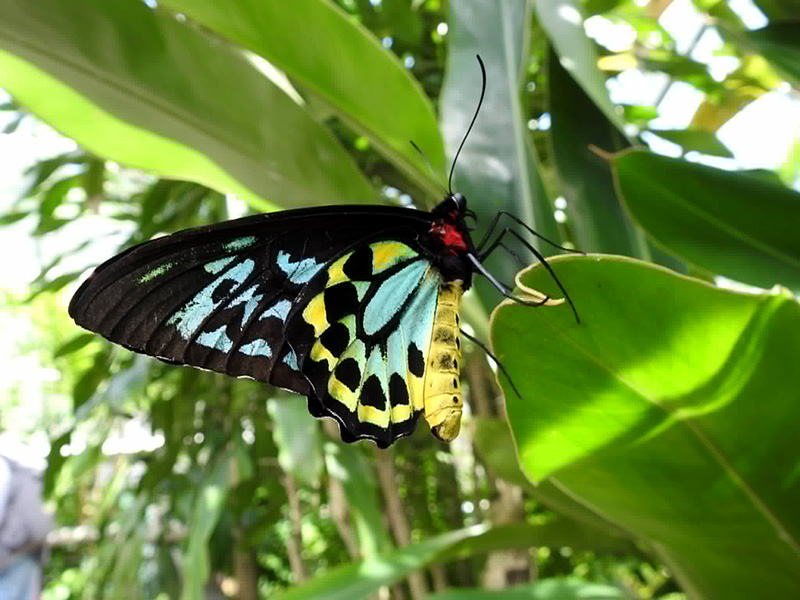
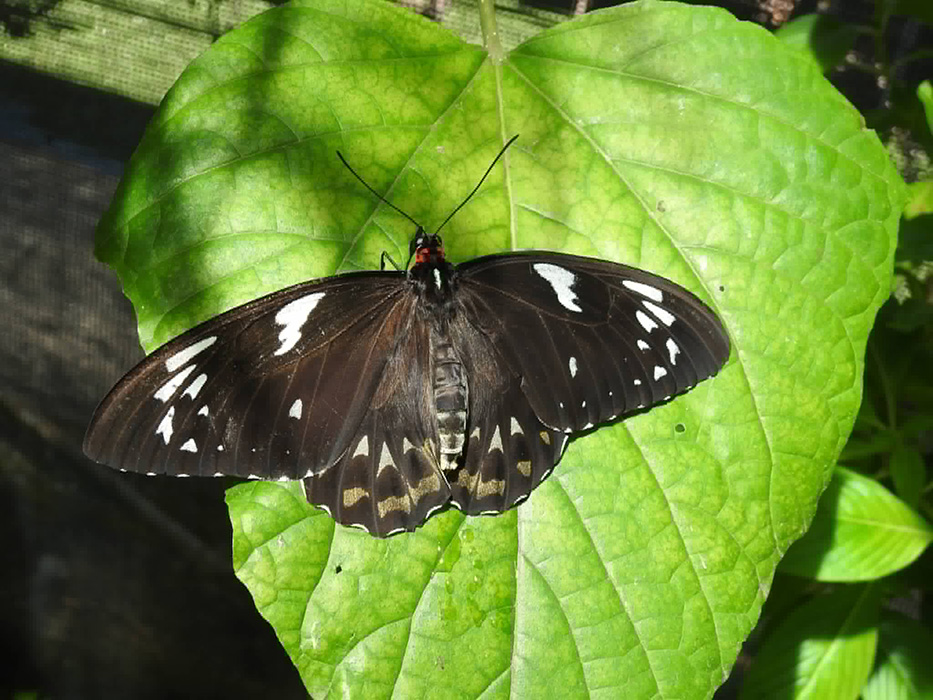
- The Female: The heavyweight of the species. She is significantly larger, with a predominantly black and white wing pattern, yellow hindwing markings, and a vivid red thorax (chest).
1. Mimicry and Camouflage: From Cryptic to Conspicuous
The life cycle of the Cairns Birdwing demonstrates a fascinating evolutionary shift in survival strategies, moving from Crypsis (hiding) to Aposematism (warning).
The Art of Hiding (The Chrysalis)
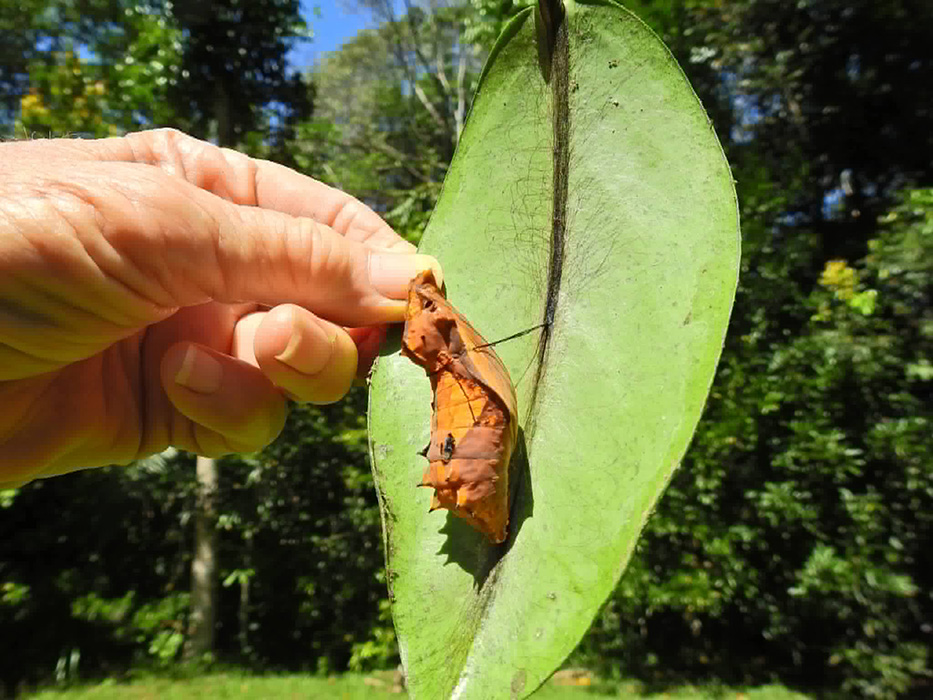
During the vulnerable pupal stage, the Birdwing cannot fly or fight. Instead, it vanishes. The chrysalis mimics the exact texture, colour, and shape of a dead, curled rainforest leaf. Suspended by a silk girdle in the canopy, this cryptic camouflage makes it nearly invisible to predatory birds.
The Art of Warning (The Adult)
Upon metamorphosis, the strategy flips. The adult butterfly does not hide; it flaunts.
- Scientific Insight: The bright red thorax of the female and the emerald flash of the male are aposematic signals. These colours warn predators of toxicity.
- The Chemistry: As larvae, the caterpillars sequester (store) aristolochic acids from their host plants. These toxins are retained through to the adult stage, making the butterfly unpalatable and poisonous to vertebrates.
2. The Invasive Threat: The Dutchman’s Pipe Trap
Conservation of the Cairns Birdwing is currently battling a case of mistaken identity caused by an invasive weed.
The Problem: Aristolochia elegans
The butterfly has co-evolved to feed exclusively on native rainforest vines. However, the introduced South American vine, Dutchman’s Pipe (Aristolochia elegans), produces a scent that mimics the native host plant.
- The Ecological Trap: Female butterflies, tricked by the similar chemical signature, lay their eggs on the invasive weed.
- The Fatal Outcome: Unlike the native vine, the leaves of the Dutchman’s Pipe are toxic to the larvae. When the caterpillars hatch and eat the leaves, they die. This “sink population” effect can devastate local butterfly numbers.
3. Conservation Strategy: “Grow It and They Will Come”
Restoring the Cairns Birdwing population is a tangible example of successful restoration ecology. The solution is simple: Habitat precision.
The Native Solution: Aristolochia tagala
The survival of the species relies on the Birdwing Butterfly Vine (Aristolochia tagala). This native lowland rainforest vine is the primary larval food source.
Creating Corridors
Because Ornithoptera euphorion is a powerful flyer, capable of travelling significant distances between rainforest fragments, planting native vines in suburban gardens creates vital “stepping stones.”
- Impact: Data suggests that removing the invasive Dutchman’s Pipe and replacing it with Aristolochia tagala leads to a rapid return of breeding populations. If you plant the specific host, the wildlife will return.
References & Scientific Resources
For further research into Australian Lepidoptera and conservation management:
- Braby, M. F. (2004). The Complete Field Guide to Butterflies of Australia. CSIRO Publishing. (Taxonomy and distribution data).
- Orr, A. & Kitching, R. (2010). The Butterflies of Australia. Allen & Unwin. (Life-history and host plant interactions).
- Sands, D.P.A. & Scott, S. (2002). Conservation of Birdwing Butterflies. SciCom. (Specific data on the Aristolochia toxicity issues).
- Queensland Government. Wet Tropics Management Authority. (Regional habitat information).
Photo Gallery