Blue Triangle Butterfly
Graphium sarpedon choredon
The Blue Triangle: A Flash of Turquoise in the Australian Rainforest
If you have ever seen a vibrant shard of stained glass zooming through an Australian garden, you have likely met the Blue Triangle (Graphium sarpedon choredon). Known for its electric colours and rapid, erratic flight, this species is a favourite among lepidopterists and nature lovers alike.
Below, we explore the biology, life cycle, and conservation of this erratic aviator, providing the essential facts for students, scientists, and gardeners.
Identification and Morphology: What Does It Look Like?
To the scientific eye, Graphium sarpedon is easily distinguishable, but to the casual observer, it is simply a stunner.
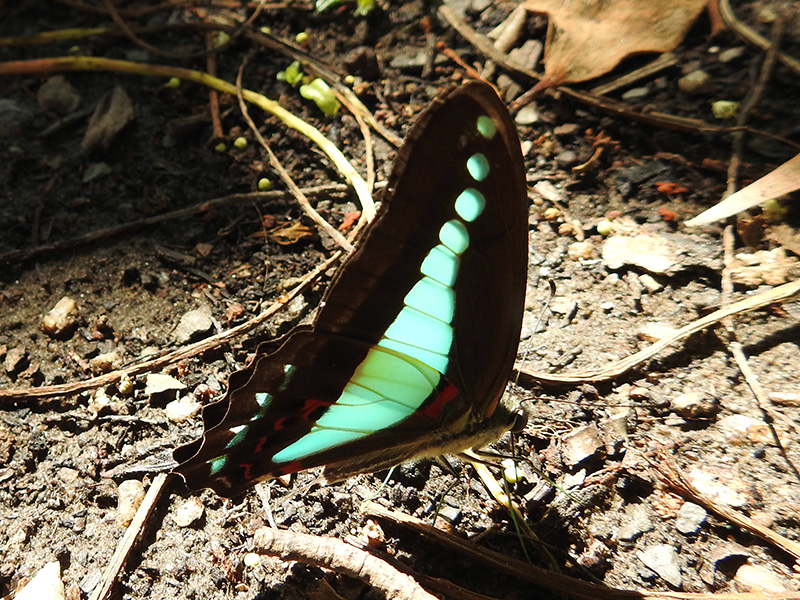
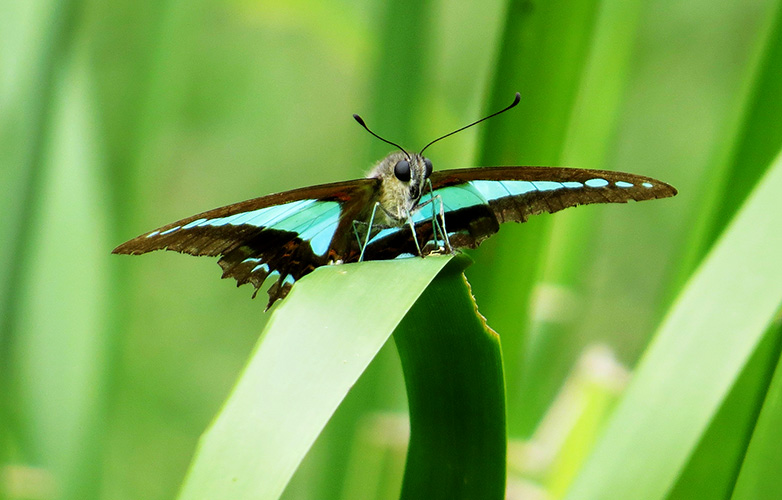
- Dorsal (Top) View: The wings are velvety black, bisected by a vibrant, central band of turquoise-blue or green. This band forms a rough triangle shape across the wings when they are spread, giving the butterfly its common name.
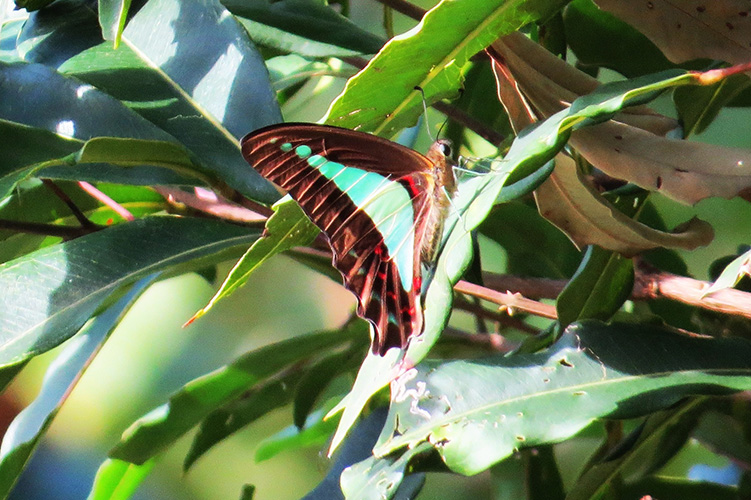
- Ventral (Underside) View: The underside presents a more cryptic pattern of black and brown, highlighted by the same blue band. However, keep an eye out for five distinctive red spots on the hindwing—these “red notes” are a key identifier.
- Wingspan: Typically ranges between 50mm to 60mm.
The Caterpillar (Larva): The larvae are master of camouflage. They are slug-like, tapering towards the tail, and usually a deep, glossy green (sometimes bluish) with a yellow or white line just above the legs. They blend perfectly with the leaves of their host plants.
Range and Habitat
The subspecies choredon is found primarily in Eastern Australia, stretching from the Torres Strait down through Queensland and New South Wales, and occasionally into Victoria.
They favour:
- Rainforests and gallery forests.
- Suburban gardens and parks (especially where Camphor Laurel is present).
- Coastal dunes and scrublands.
Longevity and Breeding Cycle
Understanding the life cycle is crucial for anyone hoping to spot or raise them. In the warm 26°C conditions you are currently enjoying, this cycle moves quite quickly!
- The Egg: Females lay spherical, pale yellow eggs singly on the new growth of host trees.
- The Larva: Upon hatching, the caterpillar eats voraciously. It rests on the upper side of the leaf, often spinning a silk pad for grip.
- The Pupa (Chrysalis): The chrysalis is green (cryptic camouflage) with a yellow stripe and is suspended head-up by a silk girdle, usually on the underside of a leaf.
- The Adult (Imago):
- Longevity: Like many swallowtails, the adult life is fleeting, typically lasting 2 to 4 weeks. Their primary goal during this time is reproduction.
- Generations: In warmer climates (like QLD), they can breed year-round. In cooler southern areas, the pupa may enter diapause (dormancy) to survive the winter, emerging when the weather warms.
Interesting Facts
- Speed Demons: The Blue Triangle is one of Australia’s fastest garden butterflies. They rarely settle for long, often feeding on nectar while their wings continue to vibrate—a behaviour known as “hover feeding.”
- Mud-Puddling: You will often see males gathering on damp soil or mud. They are not just drinking water; they are siphoning up dissolved salts and minerals necessary for reproduction.
- Chemical Warfare: The caterpillar possesses an osmeterium—a fleshy, red-yellow, fork-like organ behind its head. When threatened, it pops this organ out to release a pungent, sweet-acidic smell (reminiscent of rancid butter) to drive away ants and predators.
Conservation Status and Threats
Current Status: Secure (Least Concern). The Blue Triangle is relatively common and has actually adapted well to urbanization, largely due to its ability to feed on introduced tree species.
Threats:
- Habitat Loss: The destruction of remnant rainforests.
- Indiscriminate Weed Removal: While we generally want to remove invasive weeds, the mass removal of Camphor Laurel (Cinnamomum camphora) without replacing them with native laurels can cause local population crashes, as this has become a primary food source in cities.
- Pesticides: Domestic sprays in gardens often kill the larvae before they can mature.
How You Can Help (Actionable Steps)
To optimise your garden for these visitors, consider the following biological interventions:
- Plant Native Hosts: The best way to support them is to plant trees from the Laurel family (Lauraceae).
- Cryptocarya species (Native Laurels).
- Neolitsea dealbata (White Bolly Gum).
- Doryphora sassafras (Sassafras).
- Leave the Camphor (Cautiously): If you have a large Camphor Laurel, consider controlling its spread rather than removing it entirely until your native replacement trees are established.
- Nectar Traps: Adults love flowers with easy access to nectar. Plant Buddleja, Lantana (controlled), Ixora, and native Melaleuca species.
- Water Stations: Create a shallow “puddle” with sand and rocks in your garden to encourage male mud-puddling.
References and Further Reading
To ensure the highest standard of accuracy for your visitors, please consult these reputable sources:
- Australian Museum: Blue Triangle Butterfly facts and identification. Visit Website
- Coffs Harbour Butterfly House: Graphium sarpedon – Detailed life cycle and photography. Visit Website
- Atlas of Living Australia: Scientific data and mapping of Graphium sarpedon choredon. Visit Website
Photo Gallery