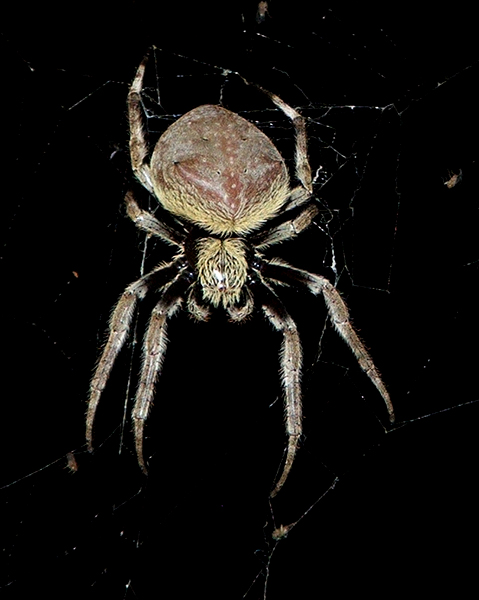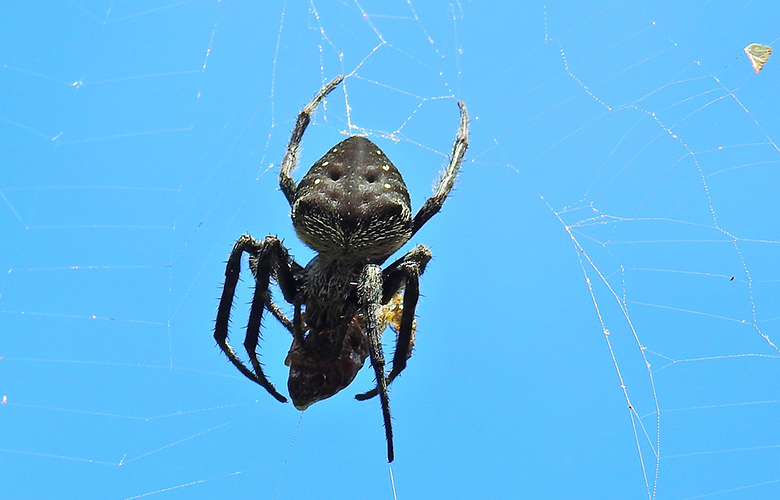
Australian Garden orb weaver spider
Australian Garden Orb‑Weaver Spider
As evening settles over Australian gardens, a quiet architect goes to work. Almost unnoticed, the Australian garden orb‑weaver spider emerges and begins to weave one of nature’s most elegant structures. Scientific, harmless, and highly beneficial, Hortophora transmarina is one of the most familiar spiders in Australia—and one of the most important.
Scientific Classification
- Class:
Arachnida - Order:
Araneae - Family:
Araneidae - Genus:
Hortophora - Species: Hortophora transmarina
Until recently, this species was grouped under the genus Eriophora. Advances in spider taxonomy have since clarified its classification.
Identification and Appearance
The Australian garden orb‑weaver is a medium to large spider, with females significantly larger than males.
Key features:
- Rounded, bulbous abdomen
- Colour varies from grey and brown to reddish tones
- Often marked with leaf‑like or mottled patterns
- Long, sturdy legs adapted for web building
Females can reach 2–3 centimetres in body length, while males are much smaller and more slender.
Where Are They Found?
Hortophora transmarina is widespread across:
- Eastern and southern Australia
- Urban gardens
- Bushland edges
- Forests and parks
They thrive in areas where insects are abundant and anchor points for webs—such as fences, shrubs, and verandas—are easy to find.
Web‑Building Behaviour
This species is best known for its large, circular orb web, which can span over a metre in diameter.
Web behaviour:
- Built at dusk or during the night
- Carefully dismantled or eaten by morning
- Rebuilt nightly using recycled silk proteins
The silk is strong, elastic, and perfectly tuned to stop flying insects without breaking.
Diet and Hunting
Australian garden orb‑weavers feed primarily on:
- Moths
- Flies
- Beetles
- Mosquitoes
Once prey becomes trapped, the spider:
- Rushes from the web’s edge
- Wraps the insect in silk
- Injects venom to immobilise it
This makes them highly effective natural pest controllers.
Venom and Human Safety
Despite their size, Australian garden orb‑weavers are not dangerous to humans.
- Their venom is mild
- Bites are rare and usually occur only if the spider is handled
- Symptoms are typically limited to minor pain or redness
These spiders are considered safe and should not be killed.
Life Cycle and Longevity
The life of Hortophora transmarina follows a seasonal rhythm:
- Eggs hatch in spring or early summer
- Juveniles disperse and grow through several moults
- Adults are most noticeable in late summer and autumn
Females often die after laying eggs, completing a single breeding season.
Role in the Ecosystem
Garden orb‑weavers play a vital ecological role by:
- Reducing insect populations
- Supporting urban biodiversity
- Providing food for birds and reptiles
Their presence is a sign of a healthy, balanced environment.
Living Alongside Garden Orb‑Weavers
In gardens and around homes:
- They are best left undisturbed
- Webs can be gently relocated using a stick if needed
- Turning off outdoor lights can reduce insect attraction at night
Learning to recognise this species helps replace fear with appreciation.
A Spider Worth Protecting
The Australian garden orb‑weaver is a skilled engineer, a patient hunter, and a quiet guardian of our gardens. Night after night, it spins its web, captures pests, and disappears by morning—leaving little trace of its work.
🕸️ Understanding this spider helps us see our gardens not just as human spaces, but as shared ecosystems.
Photo Gallery