AUSTRALIAN SPOTTED CRAKE
Australian Spotted Crake
Among the dense reeds and tangled vegetation of Australia’s wetlands lives one of the most secretive and beautifully patterned birds in the country — the Australian Spotted Crake (Porzana fluminea). Small, shy, and rarely seen in the open, this bird spends most of its life quietly slipping through the shadows of marshes and flooded grasslands.
Because of its elusive nature, many people may walk past a wetland dozens of times without ever realising this remarkable bird is living just metres away. For those lucky enough to glimpse it, however, the Australian Spotted Crake is a truly special sight.
What Does the Australian Spotted Crake Look Like?
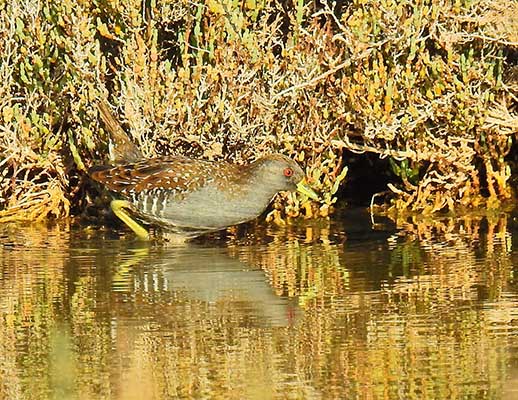
The Australian Spotted Crake is a small rail, typically measuring 19–22 centimetres in length, with a compact body and relatively long toes that allow it to walk easily across floating vegetation.
Its plumage is one of the most striking among Australia’s wetland birds:
- Upper body: Rich olive‑brown to dark brown feathers covered in neat white spots.
- Face and throat: Grey to slate‑coloured.
- Flanks: Dark with bold white spotting.
- Bill: Short and greenish‑yellow.
- Eyes: Bright red, standing out against the darker head.
Despite its colourful markings, the crake’s small size and habit of staying close to cover make it surprisingly difficult to see.
Habitat and Distribution
The Australian Spotted Crake is found throughout much of Australia, New Zealand, and parts of Indonesia and the Pacific. In Australia, it occurs across most regions where suitable wetland habitat exists.
It prefers areas with dense aquatic vegetation, such as:
- freshwater marshes
- reedbeds and sedge wetlands
- flooded grasslands
- lake margins
- billabongs and swamps
The bird rarely ventures far from cover, using thick vegetation for both protection and feeding.
Feeding Habits
The Australian Spotted Crake is an opportunistic feeder that forages along muddy edges and shallow water.
Its diet includes:
- aquatic insects and larvae
- small crustaceans
- worms
- snails
- seeds and plant material
Rather than diving like a cormorant or darter, the crake carefully walks through shallow water and vegetation, picking prey from the surface or probing into mud with its bill.
They are most active during dawn, dusk, and nighttime, which adds to their reputation as one of the wetlands’ most elusive birds.
Breeding and Nesting
Breeding typically occurs during spring and summer, especially when wetlands fill with water after rain.
- Nest location: hidden in dense reeds or grass close to the water’s edge
- Nest structure: a small cup made from grasses and reeds
- Eggs: usually 4–6 cream or buff eggs speckled with brown
- Parental care: both parents take part in incubation and caring for the chicks
The young chicks are covered in black down and are able to move around shortly after hatching, following their parents through the vegetation.
Longevity
The exact lifespan of the Australian Spotted Crake in the wild is not well documented, largely due to its secretive habits. However, like many small wetland rails, individuals are believed to live around 5 to 8 years under favourable conditions.
Survival depends heavily on stable wetland habitats and protection from predators.
Indigenous Connections
Wetland birds such as crakes have long been part of the landscapes managed and understood by First Nations peoples across Australia. Their presence within reedbeds and flooded grasslands reflects healthy wetland systems that support insects, fish, and plant life.
Traditional ecological knowledge recognises that the appearance and behaviour of waterbirds can indicate seasonal changes, rainfall patterns, and the condition of waterways.
Because Australia contains many different Indigenous language groups, traditional names for this species vary regionally and are not always widely recorded in public sources. Acknowledging these birds as part of living wetland ecosystems reflects the deep cultural knowledge and long‑standing care of Country practiced by Traditional Owners.
Conservation Status and Threats
The Australian Spotted Crake is currently considered a species of Least Concern, but it remains dependent on healthy wetland habitats.
Major threats include:
- drainage and loss of wetlands
- pollution and poor water quality
- habitat degradation from livestock
- introduced predators such as cats and foxes
Because these birds rely heavily on dense vegetation, even small changes to wetland structure can affect their survival.
How You Can Help
Protecting wetlands helps many species, including the Australian Spotted Crake.
You can help by:
- supporting wetland conservation and restoration projects
- reducing pollution entering rivers and lakes
- keeping pets away from sensitive wetland habitats
- respecting natural vegetation along water edges
Why the Australian Spotted Crake Matters
Although small and rarely seen, the Australian Spotted Crake plays an important role in wetland ecosystems by feeding on insects and other small animals. Its presence signals a healthy marsh environment rich in life.
In the quiet shadows of Australia’s reedbeds, this beautiful little bird continues to thrive — a reminder that some of the most remarkable wildlife lives just out of sight.
Scientific References
- BirdLife Australia – Australian Spotted Crake species profile
- Australian Museum – Spotted Crake information
- Pizzey, G. & Knight, F. The Field Guide to the Birds of Australia
- Department of Climate Change, Energy, the Environment and Water – Wetland bird information
- Wikipedia – Porzana fluminea (Australian Spotted Crake)
Photo Gallery