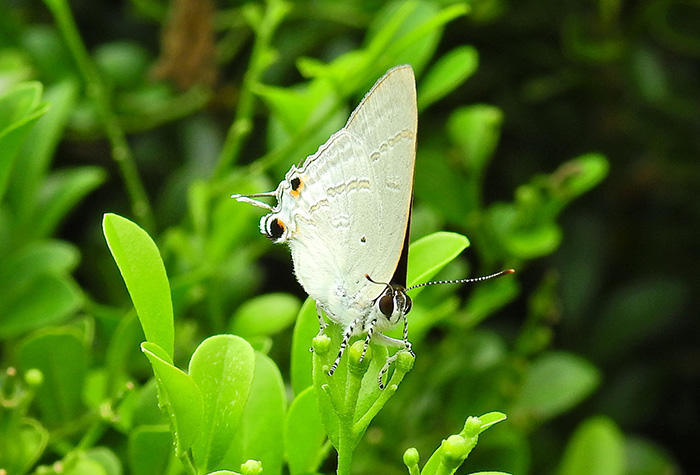
Black-spotted Flash Butterfly
The Flash of the Forest: Black‑spotted Flash
The Black‑spotted Flash (Hypolycaena phorbas) also known as the Common Tit, is a small but beautiful butterfly recorded in northern Australia, where it flits through tropical forests, woodland edges, and sunny clearings with a quick, flashing flight. As its name suggests, this butterfly is easy to miss — but when sunlight catches its wings, it can be a striking sight.
Belonging to the Lycaenidae family, the group that includes the blues, coppers, and hairstreaks, the Black‑spotted Flash is one of those species that rewards patience. It is tiny, restless, and delicate, yet full of character.
What Does the Black‑spotted Flash Look Like?
The Black‑spotted Flash is a small butterfly, typically with a wingspan of about 25–35 millimetres.
Its appearance is subtle but distinctive:
- Upper wings: dark brown to blackish, often with a bluish sheen in the light
- Underside: paler, with neat black spots and fine markings
- Tail: a small tail-like extension on the hindwings, a classic lycaenid feature
- Body: slender and lightly built
- Flight style: quick, darting, and “flashing” as it moves through vegetation
Males are often more brightly coloured than females, especially when the light catches the wings at the right angle. Their rapid, flickering movement is part of what makes them so hard to follow in the forest.
Habitat and Distribution
The Black‑spotted Flash is recorded from tropical northern Australia, particularly in forested and lightly wooded areas.
It is associated with habitats such as:
- tropical rainforest margins
- open woodland
- forest clearings
- shaded tracks and gullies
- warm, sheltered vegetation around the northern tropics
Outside Australia, the species also occurs in parts of New Guinea and nearby tropical regions.
Because it is small and quick, it is often overlooked unless you are specifically watching for butterflies in the right habitat.
Feeding Habits
Adult Black‑spotted Flash butterflies feed on flower nectar and are usually seen visiting small blooms in warm, sunny patches.
They may also take moisture and minerals from damp ground, which is common behaviour in many small butterflies.
Their feeding sites can include:
- tiny forest flowers
- shrubs at the edge of clearings
- garden plants near tropical bushland
- sunlit patches where nectar is easy to reach
Like many lycaenid butterflies, they tend to stay close to cover and move rapidly between feeding spots.
Breeding and Host Plants
The breeding biology of the Black‑spotted Flash is not as widely documented in Australian public sources as some larger butterflies, but like many members of the lycaenid family, its caterpillars are likely associated with specific host plants and may also have relationships with ants.
This kind of partnership is common among the blues and hairstreaks, where ants may protect the caterpillars in exchange for sugary secretions.
Life cycle
- Egg – laid on the host plant
- Caterpillar – small, plant-feeding, and often cryptically coloured
- Pupa – formed in a sheltered place among leaves or debris
- Adult butterfly – emerges to feed and breed
The full life cycle is usually completed in a few weeks to several weeks, depending on temperature and food availability.
Longevity
Adult Black‑spotted Flash butterflies are likely short-lived, with a lifespan of around one to two weeks in the wild, which is common for many small tropical butterflies.
The total time from egg to adult is generally just a matter of weeks, allowing the species to reproduce quickly when conditions are suitable.
Interesting Facts About the Black‑spotted Flash
- Its common name comes from the butterfly’s quick, flashing movement through the forest.
- It is part of the large and diverse Lycaenidae family.
- The species is small enough to be easily overlooked, even when it is common locally.
- Its subtle beauty is easiest to see when it pauses briefly in sunlight.
- Like many tropical butterflies, it is tied closely to the health of native vegetation.
There is something wonderfully fleeting about this butterfly — a tiny dark spark that darts through the greenery and vanishes again almost instantly.
Indigenous Connections
Butterflies are part of the broader seasonal rhythms observed by First Nations peoples across Australia. Their appearance often follows flowering, rainfall, and new plant growth in the landscape.
In traditional ecological knowledge, insects such as butterflies are part of the interconnected living systems of Country. Their presence can reflect the health of vegetation and the balance of local ecosystems.
Because Australia contains many Indigenous language groups, traditional names for butterflies vary across regions and are not always widely recorded in public sources. Recognising butterflies like the Black‑spotted Flash as part of these living systems helps acknowledge the deep ecological understanding held by Traditional Owners.
Conservation Status and Threats
The Black‑spotted Flash is not currently known to be threatened in Australia, but as with many small forest butterflies, its survival depends on healthy habitat.
Potential threats include:
- rainforest clearing
- habitat fragmentation
- loss of host plants
- pesticide use
- climate change affecting tropical vegetation
Protecting native forest edges and keeping vegetation intact helps support this and many other small butterfly species.
What Can We Do to Help the Species?
You can help Black‑spotted Flash butterflies by:
Protecting native vegetation
Leave forest edges, shrubs, and small clearings intact where possible.Reducing pesticide use
This helps protect both caterpillars and adult butterflies.Planting butterfly‑friendly native species
Nectar plants and host plants support local butterfly populations.Keeping a natural understory
Small butterflies often rely on sheltered, layered vegetation.
Why the Black‑spotted Flash Matters
The Black‑spotted Flash is a reminder that some of Australia’s most interesting wildlife comes in the smallest packages. Its rapid flight, subtle markings, and forest habitat make it a quietly beautiful part of the tropical butterfly world.
By protecting native bushland and rainforest edges, we help ensure that this little flash of movement continues to brighten Australia’s northern landscapes.
Scientific References
- Atlas of Living Australia – Hypolycaena phorbas records
- Australian Butterfly Conservation resources
- Braby, M. F. Butterflies of Australia: Their Identification, Biology and Distribution
- Australian Museum – Lycaenidae butterfly information
- Wikipedia – Hypolycaena phorbas
Photo Gallery