Crowned stick insect
Crowned Stick Insect
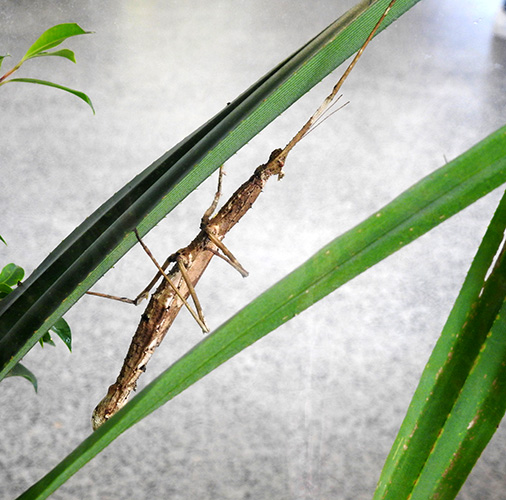
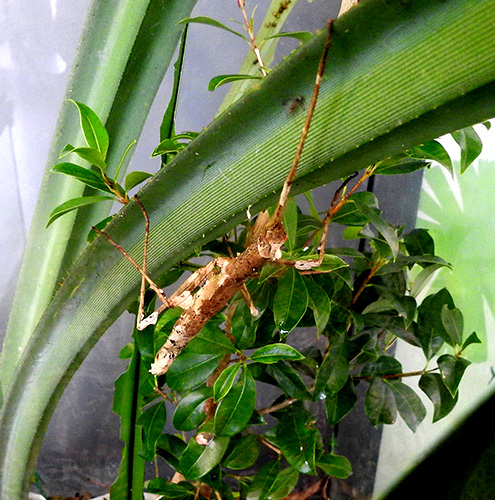
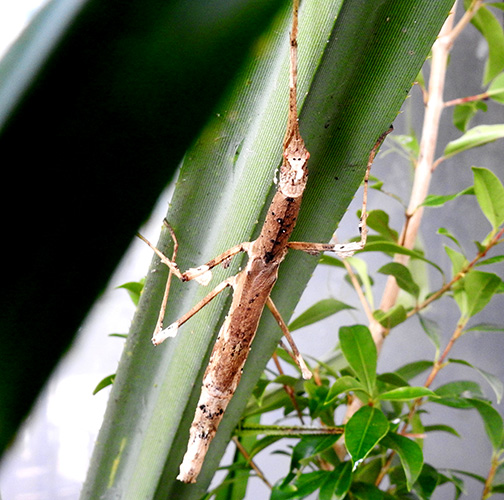
Among the shaded understory of Queensland’s tropical forests lives a stick insect unlike any other. The Crowned Stick Insect takes its name from a distinctive raised structure on its head, resembling a tiny crown. This unusual feature, combined with its dark, bark‑like colouring, makes it one of Australia’s most visually striking stick insects.
Described scientifically in 2006, this species is relatively new to science, yet it has long existed quietly within the rainforest, perfectly adapted to life among shadows, leaf litter, and tree trunks.
Identification and Appearance
The Crowned Stick Insect is a medium‑sized phasmid, with adults reaching up to 12 centimetres in length.
Females are broader and heavier‑bodied, usually coloured in shades of brown, grey, or black. Their bodies are strongly textured, creating an excellent bark‑like camouflage when resting on tree trunks or fallen logs.
Males are slimmer and more lightly built. Both sexes possess a noticeable crown‑shaped projection on the head, a defining feature of the species.
When threatened, adults may suddenly open their wings, revealing deep purple and dark patterned inner wings, a startling display designed to deter predators.
Habitat and Distribution
The Crowned Stick Insect is endemic to north‑eastern Queensland, where it inhabits tropical rainforest environments within the Wet Tropics region.
It is most commonly found in:
- Coastal and mountain rainforests
- Moist forest understory
- Areas with dense vegetation and fallen timber
Unlike many canopy‑dwelling stick insects, this species is often found low to the ground, sheltering on or beneath logs, within leaf litter, or among low foliage during the day.
Behaviour and Lifestyle
Onchestus rentzi is primarily nocturnal. At night, it becomes active, climbing vegetation to feed on leaves. During the day, it relies on camouflage and stillness to avoid detection.
Both sexes have wings when mature. Females are unable to fly due to their heavier bodies, while males can fly short distances. In both sexes, wings are used mainly as a defensive display, rather than for regular movement.
Diet
In the wild, the Crowned Stick Insect feeds on a variety of native plants. Known food plants include:
- Eucalyptus species
- Acacia (wattle)
- Other rainforest and woodland foliage
This flexible diet allows the species to thrive in different rainforest microhabitats.
Life Cycle and Longevity
The life cycle follows the typical stick insect pattern of incomplete metamorphosis.
Females drop eggs individually onto the forest floor, where they closely resemble pieces of bark or seeds.
Eggs usually hatch after several months, depending on temperature and humidity.
Nymphs grow slowly, moulting multiple times before reaching adulthood.
Females may live for 12 to 18 months, while males generally have a shorter lifespan.
Ecological Role
The Crowned Stick Insect plays a subtle but important role in rainforest ecosystems. As a leaf‑eating herbivore, it contributes to plant growth regulation and forms part of the food web, supporting birds, reptiles, and small mammals.
Its presence is an indicator of healthy, well‑structured rainforest environments.
Conservation Notes
This species is not currently listed as threatened, but it depends on intact rainforest habitat. Land clearing, fragmentation, and changes to forest structure can reduce suitable shelter and food plants.
Protecting rainforest ecosystems in north‑eastern Queensland helps ensure the survival of this and many other specialised insect species.
Interesting Facts
The species is named after Australian entomologist David Rentz.
Its “crown” is present in both males and females.
Inner wings are often hidden and only revealed when the insect feels threatened.
Despite their dramatic appearance, Crowned Stick Insects are harmless to humans.
They are among the few Australian stick insects commonly found resting close to the ground.
A Hidden Jewel of the Rainforest
The Crowned Stick Insect reminds us that Australia’s rainforests hold many remarkable creatures that are easily overlooked. Through patience, observation, and habitat protection, we can continue to learn from species like Onchestus rentzi, whose quiet existence speaks volumes about the complexity of Australia’s natural world.
Photo Gallery