DOUBLE-EYED FIG PARROT
Double-eyed Fig Parrot
High in a fruiting fig tree, a small green bird moves quietly between the leaves. For a moment, a flash of blue and red reveals its face. Then it disappears into the canopy again, its plumage blending almost perfectly with the foliage.
The Double-eyed Fig Parrot (Cyclopsitta diophthalma) is Australia’s smallest parrot. Although brightly coloured, this little rainforest bird can be surprisingly difficult to find. Often, a sharp call or a shower of discarded fruit fragments provides the first clue that it is feeding overhead.
Found in north-eastern and eastern Australia, as well as New Guinea and nearby islands, Double-eyed Fig Parrots are closely connected to forests that provide fruiting trees and suitable nesting places.
What Does the Double-eyed Fig Parrot Look Like?
Measuring approximately 13–16 centimetres long, the Double-eyed Fig Parrot has a compact body, a very short tail and a relatively large head. Its strong bill is well suited to opening fruit and reaching the seeds inside.
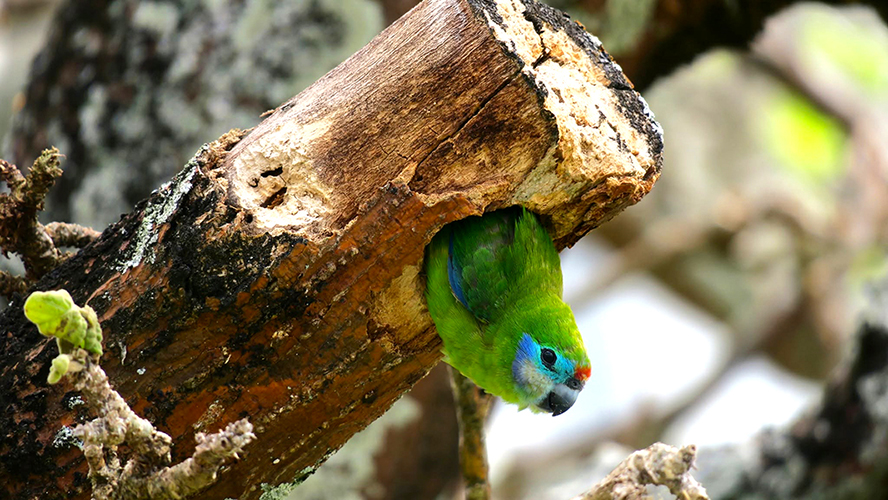
Most of its plumage is bright green, helping it blend into rainforest leaves. Colourful facial markings include combinations of red, blue and yellow, although the exact pattern varies between populations and sexes.
Its unusual name refers to the coloured patches around the eye, which can give the impression of an additional eye. It does not actually have two pairs of eyes.
Males generally have more extensive red facial colouring than females, but identification requires care because the different Australian forms have different cheek patterns.
In flight, these tiny parrots travel swiftly on rapidly beating wings, often appearing as little more than a green blur.
What Does the Double-eyed Fig Parrot Sound Like?
Double-eyed Fig Parrots make short, high-pitched calls, often described as sharp “seet” or “tsit” notes. These calls may be repeated as birds fly between trees or communicate with one another.
They can be quiet while feeding, particularly when concentrating on a plentiful supply of fruit. Listening for their thin calls is often more useful than searching for their green bodies among the leaves.
Where Do Double-eyed Fig Parrots Live?
Double-eyed Fig Parrots inhabit tropical and subtropical forests, especially places with a reliable supply of figs and other suitable fruits.
Their habitats include:
- Tropical and subtropical rainforest.
- Rainforest edges and adjoining woodland.
- Forest along rivers and creeks.
- Some parks and gardens near suitable forest, particularly where mature fig trees grow.
Traditionally, three Australian subspecies have been recognised:
- Macleay’s Fig Parrot (C. d. macleayana), found in north-eastern Queensland.
- Marshall’s Fig Parrot (C. d. marshalli), found in parts of Cape York Peninsula.
- Coxen’s Fig Parrot (C. d. coxeni), associated with south-eastern Queensland and north-eastern New South Wales.
Taxonomic note: Some modern bird classifications recognise Coxen’s Fig Parrot as a separate species, Cyclopsitta coxeni. Other sources retain it as a subspecies of the Double-eyed Fig Parrot, so both names may appear in conservation information.
What Do Double-eyed Fig Parrots Eat?
Despite their name, Double-eyed Fig Parrots do not simply eat the soft flesh of figs. The seeds inside the fruit are an especially important part of their diet.
Using their strong bills, they break into figs and other fruits to reach the seeds. They also eat other plant material and may take small insects.
While feeding, they climb along branches and cling in awkward positions to reach fruit. Small pieces often fall beneath the tree, leaving evidence of their meal.
Fruiting trees do not all produce food at the same time. A landscape containing a variety of native trees helps provide feeding opportunities throughout the year.
Behaviour: Small, Fast and Easily Overlooked
Double-eyed Fig Parrots are commonly seen in pairs or small groups. Several birds may gather at a productive feeding tree.
They spend much of their time in the canopy, where their small size and green plumage make them difficult to detect. Their movements can follow changing food supplies as different trees come into fruit.
A mature fig tree can become a busy feeding place, bringing these parrots together with other fruit-eating birds. Yet even in a tree full of activity, a feeding fig parrot may remain almost invisible.
Breeding and Nesting
Double-eyed Fig Parrots usually nest in cavities that they excavate in decaying wood, such as a dead branch or a rotten section of a tree.
This makes suitable nesting timber an important part of their habitat. A forest needs more than healthy, fruit-bearing trees: ageing trees and decaying branches also provide essential resources.
The female generally lays two eggs and undertakes incubation. The male helps provision her, and both parents contribute to feeding the young.
Breeding timing varies with location and local conditions. After hatching, the chicks remain sheltered inside the nesting cavity for several weeks before fledging.
How Long Do Double-eyed Fig Parrots Live?
The lifespan of Double-eyed Fig Parrots in the wild is not well established. Their small size, canopy-dwelling habits and the difficulty of following individual birds over many years limit the available information.
Captive longevity figures should not be treated as a reliable guide to wild lifespan. In nature, survival depends on food availability, habitat quality, predators, disease and weather conditions.
Conservation Status
The Double-eyed Fig Parrot, when assessed broadly as Cyclopsitta diophthalma, is listed as Least Concern on the IUCN Red List. However, this overall assessment does not mean that every Australian population is secure.
Coxen’s Fig Parrot is of particular conservation concern. It is exceptionally rare, with very few confirmed modern records, and is recognised as threatened under Australian conservation legislation.
Its secretive behaviour and the difficulty of confirming sightings make its remaining distribution and population size uncertain.
Conservation listings can change, and the treatment of Coxen’s Fig Parrot as a species or subspecies varies between authorities. The official resources below provide the most current listing information.
Threats to Double-eyed Fig Parrots
Habitat Loss and Fragmentation
Clearing rainforest and adjoining forest removes feeding trees and nesting sites. When remaining habitat becomes separated into small patches, birds may have fewer opportunities to move safely between food sources.
Loss of Mature Trees and Nesting Wood
The removal of large native figs, old trees and decaying timber can reduce both food and breeding opportunities.
Although unsafe branches sometimes need to be removed near buildings or paths, retaining suitable habitat trees where it is safe to do so benefits many native animals.
Extreme Weather and Habitat Damage
Cyclones, severe storms, drought and fire can damage feeding and nesting habitat. Small, isolated populations may have less capacity to recover when important habitat is lost.
How You Can Help Double-eyed Fig Parrots
- Protect native forest, including rainforest remnants and vegetation along waterways.
- Retain mature native fig trees wherever space and safety allow.
- Plant locally native species suited to your region, garden size and growing conditions. Some rainforest figs become very large, so seek advice before planting.
- Preserve suitable old trees and nesting timber where they do not present a safety risk.
- Keep cats contained, ideally indoors or within a secure outdoor enclosure.
- Observe quietly from a distance, especially near potential nesting sites.
- Avoid broadcasting bird calls to attract rare birds, as this can disturb their natural behaviour.
Interesting Facts About the Double-eyed Fig Parrot
- It is generally recognised as Australia’s smallest parrot.
- Its short tail gives it a very different outline from many other Australian parrots.
- Its name describes its facial markings, not extra eyes.
- Fig seeds are an important food source.
- It excavates nesting cavities in soft, decaying wood.
- Its brilliant colours can be remarkably difficult to see against rainforest foliage.
A Small Bird with a Strong Connection to the Forest
The Double-eyed Fig Parrot reminds us that a forest’s value lies in more than its green canopy. Fruiting figs provide food, decaying branches offer nesting places, and connected patches of vegetation allow birds to move through the landscape.
Protecting these relationships helps ensure that this tiny parrot—and the many other animals sharing its home—can continue to thrive.
References and Further Reading
- Australian Museum — Double-eyed Fig Parrot
- BirdLife Australia — Bird profiles and conservation information
- Australian Government — Species Profile and Threats Database
- NSW Government — Threatened species information
- Queensland Government — Wildlife and threatened species
- IUCN Red List — Search species assessments
Photo Gallery