Eastern tube-nosed bat
The Eastern Tube‑nosed Bat
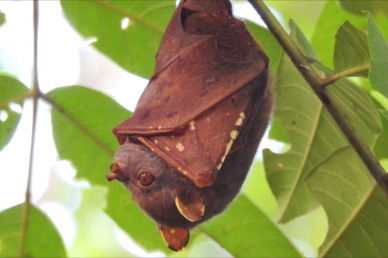
The Eastern Tube‑nosed Bat (Nyctimene robinsoni) is one of Australia’s most unusual and distinctive bats. With its large eyes, fox‑like face, and tiny tube‑shaped nostrils, it looks very different from the more familiar flying‑foxes and insect‑eating bats.
Found in the rainforests and moist forests of eastern Australia, this gentle fruit‑eating bat is an important part of the ecosystem, helping disperse seeds and maintain healthy forest vegetation.
Although the Eastern Tube‑nosed Bat is a fruit bat like the flying‑foxes, the Eastern Tube‑nosed Bat is much smaller and belongs to a different genus Nyctimene, making it one of Australia’s most unusual rainforest bats.
What Does the Eastern Tube‑nosed Bat Look Like?
The Eastern Tube‑nosed Bat is a medium‑sized fruit bat, but much smaller than the flying‑foxes.
Key features include:
- Fur: grey‑brown with scattered pale yellow spots across the body and wings
- Face: short and broad with large eyes
- Nostrils: distinctive tube‑shaped projections that give the species its name
- Wingspan: about 60–65 centimetres
- Weight: roughly 40–60 grams
The spotted pattern on the wings and body helps camouflage the bat among leaves and branches during the day.
Habitat and Distribution
The Eastern Tube‑nosed Bat occurs along the eastern coast of Australia, particularly in:
- Queensland
- New South Wales
It prefers moist forest environments, including:
- subtropical rainforest
- wet sclerophyll forest
- coastal forest
- dense woodland
Unlike flying‑foxes, which roost in large colonies, tube‑nosed bats usually roost alone or in small groups among dense foliage.
Feeding Habits
The Eastern Tube‑nosed Bat feeds mainly on fruit, especially soft rainforest fruits.
Common food sources include:
- rainforest figs
- lilly pilly fruits
- other native berries and small fruits
Rather than carrying fruit away, the bat often chews the fruit to extract the juice and then drops the pulp. Seeds are dispersed as the bat moves through the forest.
Because of this behaviour, the species plays an important role as a seed disperser, helping forests regenerate naturally.
Breeding and Life Cycle
Little is known about the detailed breeding behaviour of this secretive bat, but like many fruit bats it usually produces one young each year.
- Breeding season: generally linked to seasonal fruit availability
- Birth: the female gives birth to a single pup
- Development: the young bat clings to its mother until it is old enough to fly
Young bats gradually learn to forage independently as they grow.
Longevity
Eastern Tube‑nosed Bats can live around 10 years or more in the wild, although their exact lifespan is not as well documented as some larger bat species.
Indigenous Connections
Fruit bats and other forest animals have long been recognised within the ecological knowledge of First Nations peoples across eastern Australia. Bats that feed on fruit and flowers are part of the natural cycles that maintain forest health.
Their movements often coincide with fruiting seasons and the availability of native plants. Because Australia contains many Indigenous language groups, traditional names for this species vary across regions and are not always widely recorded in public sources.
Conservation Status and Threats
The Eastern Tube‑nosed Bat is currently considered not threatened, but it depends heavily on healthy forest habitats.
Potential threats include:
- clearing of rainforest and coastal forest
- habitat fragmentation
- loss of fruit‑bearing trees
- extreme weather events
Protecting native forests is essential for the continued survival of this species.
Why the Eastern Tube‑nosed Bat Matters
The Eastern Tube‑nosed Bat may be small and rarely seen, but it plays an important role in forest ecosystems. By dispersing seeds of native plants, it helps maintain the diversity and regeneration of rainforest habitats.
Its unusual appearance and gentle nature also make it one of Australia’s most fascinating native bats.
Scientific References
Australian Museum – Eastern Tube‑nosed Bat profile
Atlas of Living Australia – Nyctimene robinsoni records
CSIRO – Australian bat species information
Department of Climate Change, Energy, the Environment and Water – Bat conservation resources
Wikipedia – Nyctimene robinsoni (Eastern Tube‑nosed Bat)
Photo Gallery