GREAT CORMORANT
Great Cormorant
If you have ever walked along an Australian riverbank, coastal estuary, or inland lake, you have likely seen a large, dark bird sitting like a statue on a dead wooden piling, holding its wings wide open to the sun. This is the magnificent Great Cormorant (Phalacrocorax carbo).
Known in Australia through our specific regional subspecies (Phalacrocorax carbo novaehollandiae),, this highly adaptable waterbird is the ultimate aquatic hunter.
A Sleek Hunter: What Does It Look Like?
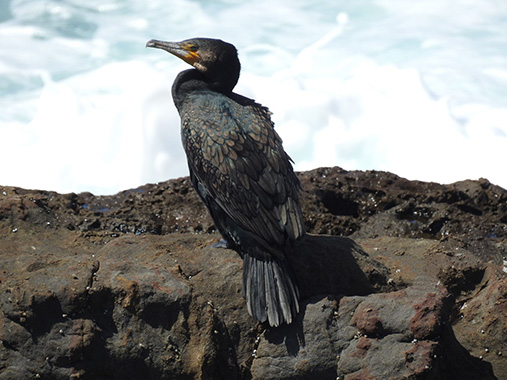
To spot a Great Cormorant is to see a bird perfectly evolved for an underwater life. They hold the title of being the largest cormorant in Australia,.
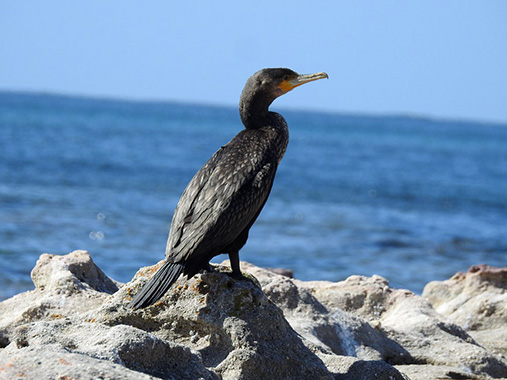
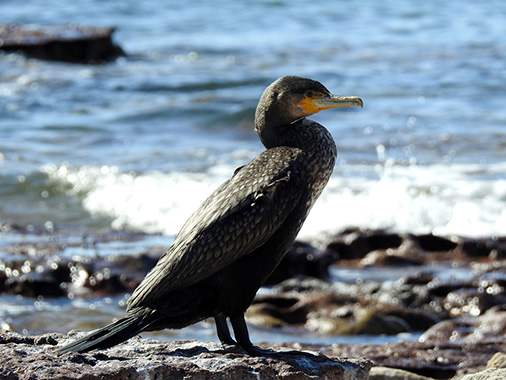
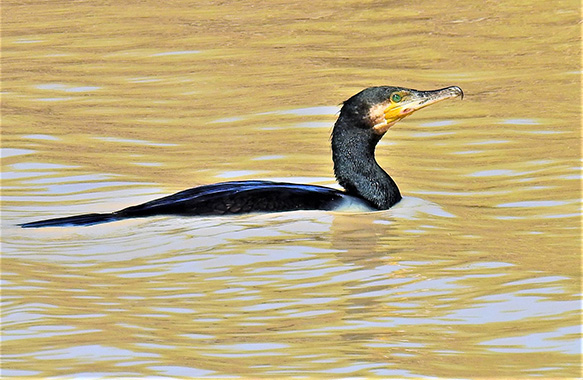
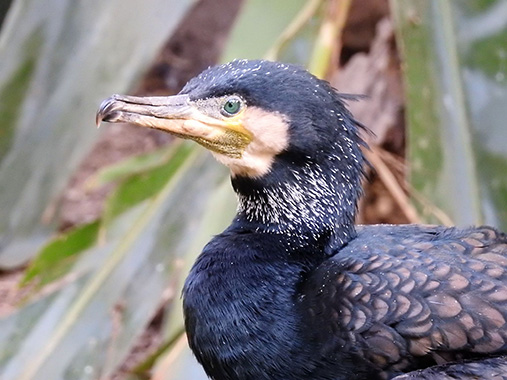
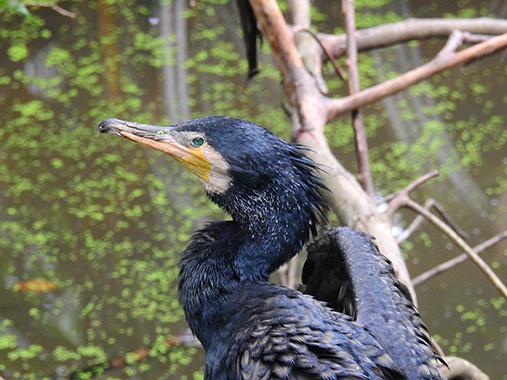
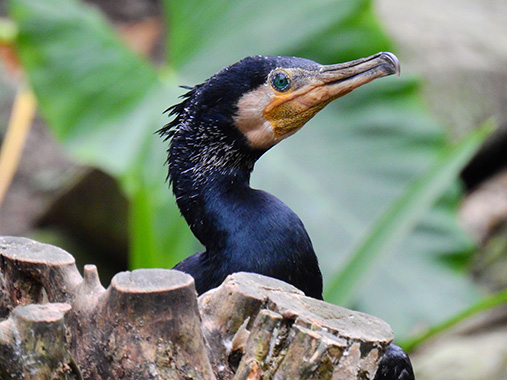
- The Adult: They are a large, robust bird, standing roughly 80 to 90 centimetres tall with a massive wingspan that can reach up to 160 centimetres,. At first glance, their plumage appears entirely black, but in the right light, it shimmers with a beautiful, glossy greenish or purplish sheen. They feature a striking yellow and white patch on their chin and throat,, and if you get close enough, you will notice their eyes are a brilliant, piercing emerald green!
- Breeding Transformation: When the breeding season arrives, the adults undergo a beautiful transformation. They develop delicate, fine white feathers (filoplumes) across their head and neck, and display a stark, prominent white patch on each of their thighs,.
- The Equipment: They sport a powerful, grey, hook-tipped bill designed perfectly for grasping slippery fish,. Their feet are completely black and heavily webbed across all four toes, making them incredibly powerful underwater swimmers,.
The Wetland Cycle: Breeding and Longevity
The Great Cormorant is a highly social bird, and their breeding events can be truly spectacular to witness.
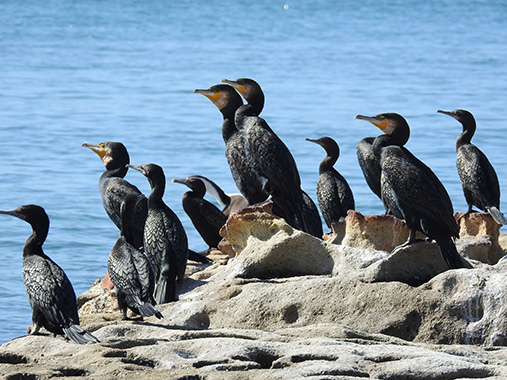
- Massive Nurseries: While they can breed at any time of the year depending on food and water availability, the peak season is typically between August and January,. They form massive, noisy breeding colonies, often consisting of around 2,000 birds, though historical mega-colonies of up to 20,000 birds have been reported,!
- Shared Parenting: Both the male and female work together to build a large, messy platform nest out of sticks, seaweed, and debris,. These are usually built low in trees overhanging the water (like River Red Gums) or right on the ground on predator-free rocky islands,. The female lays a clutch of three to five pale blue or green, chalky eggs,. Both parents share the 28 to 31-day incubation duties and take turns regurgitating fish for their voracious chicks,.
- Longevity: For such a large, hardworking bird, their lifespan is incredibly impressive. In the wild, they commonly live beyond 15 years, and banded individuals have been recorded surviving for an astonishing 22 years!
Fascinating Facts: Sunbathers and Pellets
- The Sinking Bird: Most ducks and swans have heavily oiled, waterproof feathers that keep them floating like corks. The Great Cormorant is completely different. Their feathers are specially adapted to be less waterproof. This allows their feathers to become slightly waterlogged, which drastically reduces their natural buoyancy and allows them to dive deep and swim fast underwater without constantly floating back to the surface.
- The Heraldic Pose: Because they get waterlogged, a cormorant cannot simply shake off the water and fly away. After a fishing session, they must find a sunny, breezy perch and stand completely still with their wings spread wide open—often called the “heraldic pose”—to literally air-dry their feathers in the sun.
- Casting Pellets: Just like owls, Great Cormorants swallow their prey whole. Because they cannot digest the sharp fish bones and hard scales, their stomach compacts this waste into a tight, neat little package called a pellet, which the bird simply coughs up (casts) and spits out later!
Conservation Status and Environmental Threats
Nationally and globally, the Great Cormorant is classified as a species of Least Concern,. Their robust size and incredible adaptability mean they are thriving across Australian estuaries, rivers, and inland lakes,.
However, they face constant, severe hazards in areas heavily used by humans. Their biggest threat by far is entanglement. Because they dive deeply to chase fish, they frequently become fatally tangled in discarded synthetic fishing nets, submerged crab pots, and invisible recreational fishing lines. They are also sensitive to the degradation of our inland waterways; severe blue-green algae blooms and agricultural chemical run-off can wipe out the local fish populations they rely on to feed their chicks.
What Can We Do to Help the Species?
Protecting the Great Cormorant is all about responsible recreation on our shared waterways. Here is how you can help ensure these dark submarines continue to thrive:
- Bin Your Tackle: The single most important thing you can do is to never leave fishing line behind. If your line snaps, or if you find old line tangled in the reeds, carefully cut it into small pieces and put it in a secure bin. A single metre of clear nylon line can be a death sentence for a diving cormorant.
- Use Wildlife-Safe Traps: If you use yabby or crab traps in local estuaries, ensure they are legally compliant and fitted with wildlife exclusion rings so that diving birds cannot accidentally swim inside and drown.
- Respect the Roost: If you are kayaking or boating and see a group of cormorants drying their wings on a snag, give them a wide berth. Forcing a wet cormorant to take flight burns precious energy it needs to hunt.
Scientific References
- Animal Diversity Web. Phalacrocorax carbo (great cormorant).
- Australian Museum. Great Cormorant – Phalacrocorax carbo.
- Earth Life. Great Cormorant Facts & Habitat.
- The Animal Files. Great Cormorant: Phalacrocorax carbo.
- Wikipedia Contributors. Great cormorant. Wikipedia, The Free Encyclopedia.
Photo Gallery