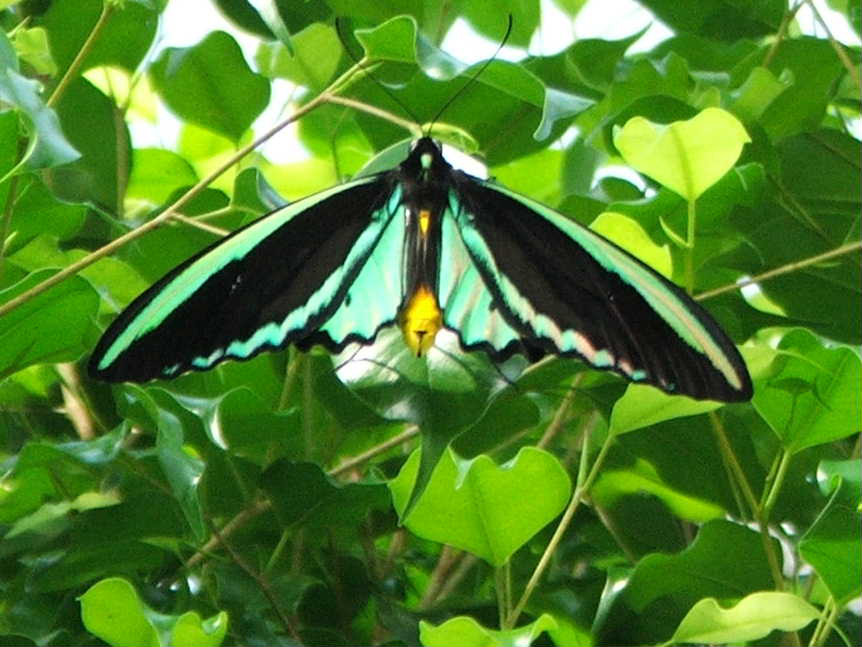
Richmond Birdwing Butterfly
The Richmond Birdwing: The Subtropical Survivor
Scientific Name: Ornithoptera richmondia Family: Papilionidae (Swallowtails) Region: Southern Queensland & Northern NSW
While its northern cousin rules the tropics, the Richmond Birdwing is the jewel of the subtropics. It is one of Australia’s largest butterflies, but its story is one of fragility and resilience. Once a common sight in the streets of Brisbane, it has now retreated to scattered pockets of rainforest.
Identification: A Smaller, but Stately Giant
Although slightly smaller than the Cairns Birdwing, the Richmond Birdwing is still massive compared to most other Australian butterflies.
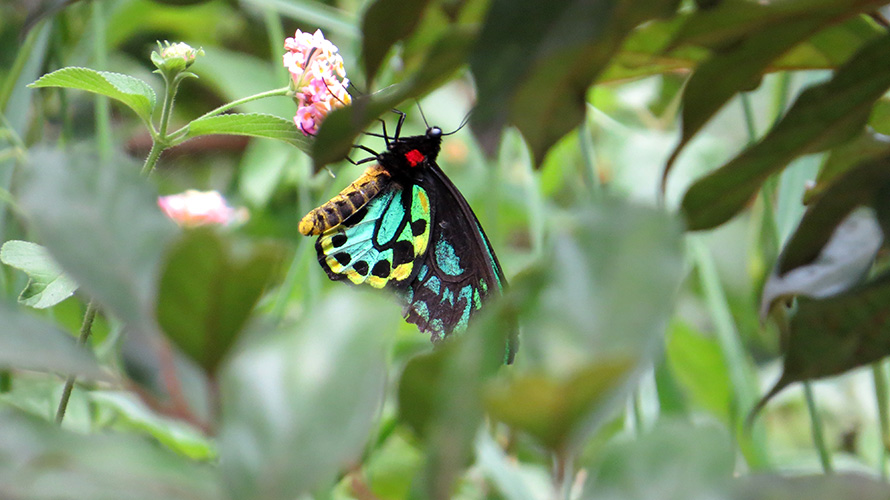
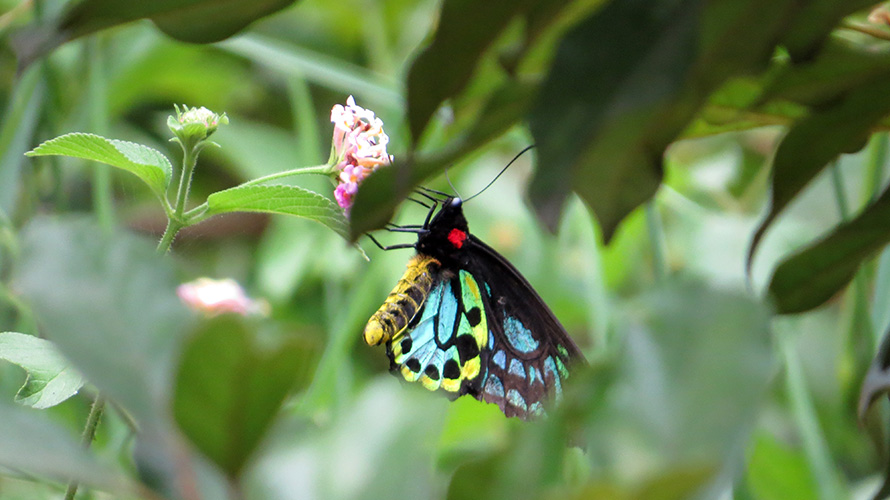
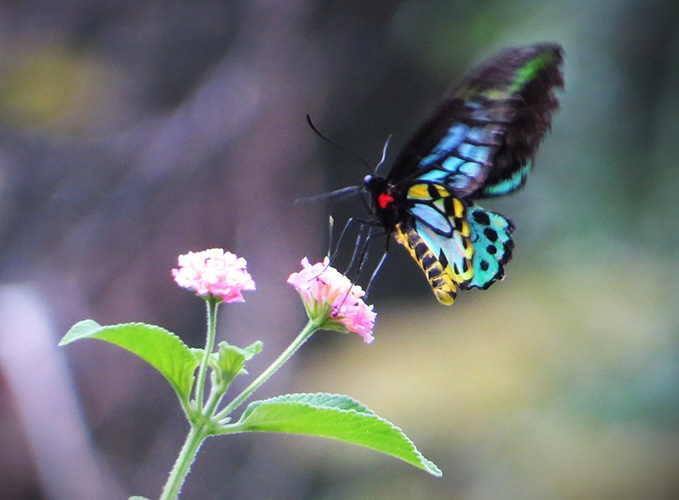
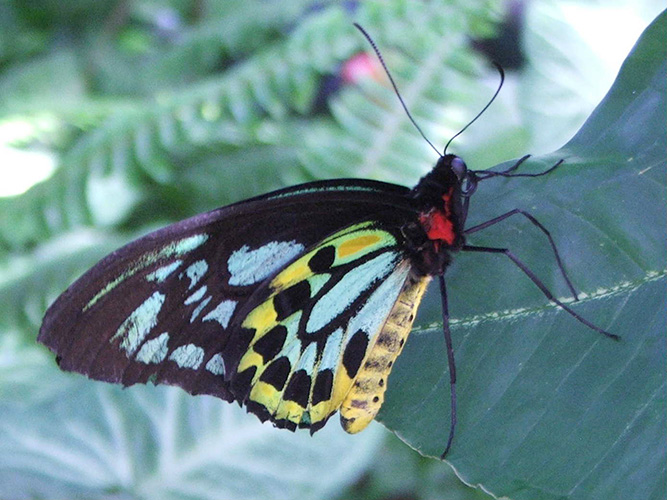
- The Male: A velvet black base with vivid shimmering patches of green and blue. He is often mistaken for a leaf in flight until the light catches his iridescent wings.
- The Female: Distinctly larger (wingspan up to 14-16cm) with a sombre but elegant pattern of dark brown, white, and cream, often with a yellow wash on the hindwings.
- Key Feature: Both sexes possess a distinctive bright red patch on the thorax (chest) beneath the wings—a warning signal to predators.
Habitat & Distribution: The “Fragmented” Kingdom
Historically, this butterfly flew continuously from Maryborough (QLD) down to Grafton (NSW). Today, that range has been shattered by urban development.
Current Range: The population is now split into two main disconnected strongholds:
- Sunshine Coast: From Kin Kin south to the Glass House Mountains.
- Gold Coast / NSW Border: From Ormeau south to Wardell (NSW).
The “Gap”: There is a notable absence of these butterflies in the greater Brisbane area (the gap between the two populations). Conservationists are working to bridge this gap by planting “corridors of green” through the suburbs.
2. Life Cycle: A Tale of Two Vines
The survival of the Richmond Birdwing is tied entirely to two specific native vines. Unlike the Cairns species which uses Aristolochia, the Richmond Birdwing relies on the genus Pararistolochia.
- Lowland Host: Birdwing Butterfly Vine (Pararistolochia praevenosa). This is the vine most gardeners should plant. It grows in coastal rainforests and cree lines below 600m.
- Highland Host: Mountain Aristolochia (Pararistolochia laheyana). 8 Found in the cooler, higher altitudes (above 600m) of the Border Ranges.
The Diapause Phenomenon: In a fascinating adaptation to the cooler southern climate, pupae (chrysalises) formed late in the season (April/May) can enter diapause (dormancy). They “sleep” through the cold winter and do not emerge as butterflies until the warm spring arrives, sometimes waiting up to 6 months!
3. The Threat: The “Dutchman’s Pipe” Trap
Just like its northern cousin, the Richmond Birdwing is threatened by the invasive weed Dutchman’s Pipe (Aristolochia elegans).
- The Deception: The invasive vine smells like the native host, tricking females into laying eggs on it.
- The Result: The leaves are toxic to the larvae, acting as a “population sink” that kills the next generation.
- Action Required: Identification and removal of this weed are critical. It acts as a “deadly magnet” in suburban gardens.
4. Conservation: “Corridors of Green”
The recovery of the Richmond Birdwing is one of Australia’s great citizen science success stories. The Richmond Birdwing Conservation Network (RBCN) coordinates efforts to reconnect the fragmented populations.
How it works: Because the butterfly is a strong flyer, it can travel between patches of rainforest. By planting Pararistolochia praevenosa in suburban gardens, schools, and parks, we create “stepping stones.”
- The Goal: To plant enough vines in the Brisbane “gap” to allow the northern and southern populations to meet and breed again, ensuring genetic diversity.
Interesting Facts
- Cannibals: The caterpillars can be cannibalistic! If there are too many eggs on one leaf, the first caterpillar to hatch might eat the remaining eggs to reduce competition for food.
- Smell-o-vision: The female “tastes” the leaf with her feet before laying eggs to ensure it is the correct vine (chemotaxis).
- Winter Sleepers: While the adults die off in winter, the species survives the cold as a dormant chrysalis, disguised perfectly as a dried leaf.
References & Further Reading
- Sands, D.P.A. & Scott, S. Conservation of Birdwing Butterflies. (The seminal work on the recovery of this specific species).
- Richmond Birdwing Conservation Network (RBCN): The primary body for current data and mapping projects.
- Queensland Government Department of Environment: Threatened Species Profile: Ornithoptera richmondia. 3
Photo Gallery