Smiley Bee
(Mellitidia tomentifera)
The Cheerful Smiley Bee of the North
A Face on its Back: Appearance
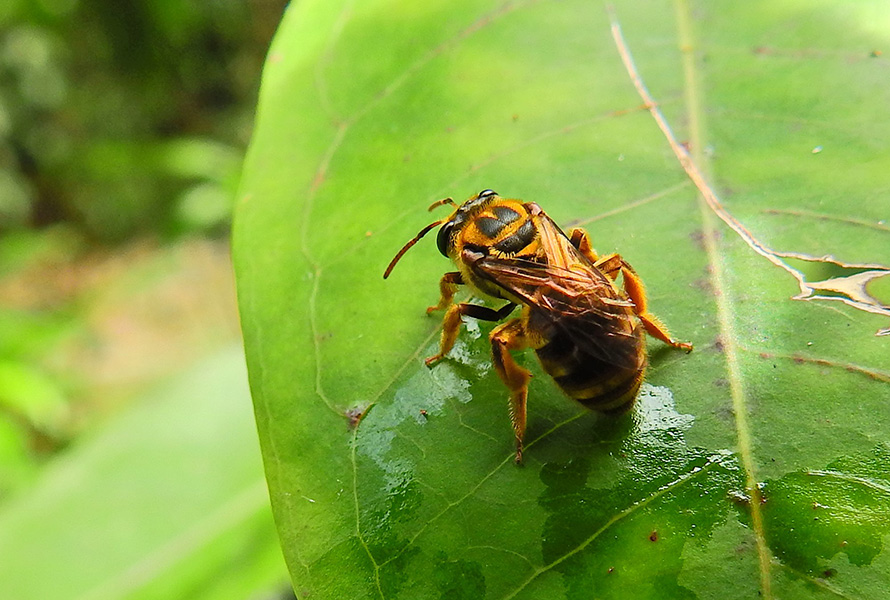
The Smiley Bee belongs to the family Halictidae (the sweat bees) and is the only species of its genus found in Australia. It has earned its whimsical nickname due to the extraordinary patterns on its thorax (the middle section of the body).
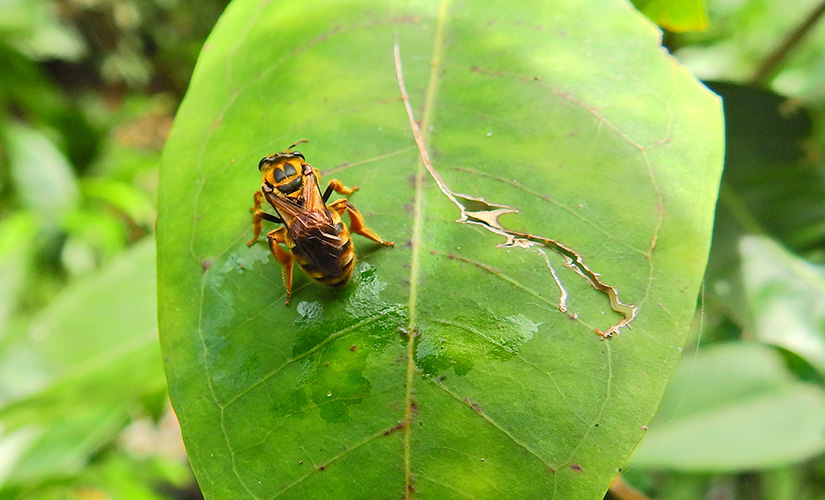
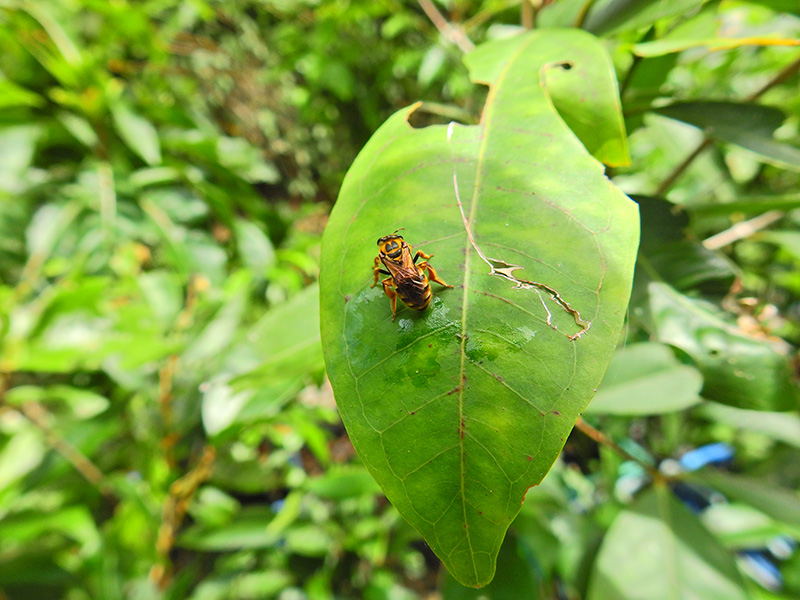
- The “Smile”: When viewed from above, the markings on the thorax perfectly resemble a yellow “smiley face” emoji. Two small black triangles look like eyes, and a curved dark line beneath them creates a perfect grin.
- Golden Beauty: Aside from its famous face, the bee is a stunning golden-yellow colour, often described as “bronzy” or “metallic” in the sunlight.
- Size: They are relatively small, typically measuring around 8–10 millimetres in length—roughly half the size of a standard European Honeybee.
Life in the Tropical North: Distribution and Habitat
The Smiley Bee is a true Queenslander. Its range is quite restricted, found almost exclusively in the coastal and rainforest regions of Far North Queensland (FNQ).
- Region: They are commonly spotted in gardens and bushlands around Cairns, the Daintree, and the Atherton Tablelands.
- Garden Visitors: They are frequent visitors to both native and exotic flowers. They have a particular fondness for the Native Raspberry (Rubus probus) and the Blue Tongue Plant (Melastoma malabithricum).
Solitary and Industrious: Breeding and Social Life
Unlike the social Honeybee that lives in a hive with a queen, the Smiley Bee is a solitary bee. This means every female is a “queen” of her own little household.
- Ground Dwellers: Females are believed to nest in the ground. They excavate small burrows in soft soil or clay banks where they create individual nursery chambers.
- Provisioning: Each chamber is stocked with a ball of pollen and nectar. The female lays a single egg on this “pollen loaf” before sealing the chamber and moving on to the next.
- No Hives: Because they are solitary, they do not produce honey or live in large colonies, making them very gentle and unlikely to sting unless handled.
A Short but Busy Life: Longevity
Like many other native solitary bees, their adult life is quite brief compared to their total life cycle.
- Adult Lifespan: An adult Smiley Bee typically lives for only 4 to 6 weeks. During this time, they are in a race against time to feed, mate, and build nests for the next generation.
- The Long Sleep: While the adults are short-lived, the larvae stay safe underground for nearly a year, developing through the wet season and emerging as new adults when the weather warms and flowers begin to bloom again.
Remarkable Behaviours and Facts
- Buzz Pollination: Smiley Bees are known for “buzz pollination” (sonication). They grab onto a flower and vibrate their flight muscles rapidly, creating a high-pitched buzz that shakes the pollen loose from flowers that other bees might struggle to pollinate.
- UV Markings: To our eyes, the smiley face is a novelty, but to other bees, these patterns reflect light in the ultraviolet spectrum, helping them communicate or identify one another in the dense rainforest.
- A “Little Known” Species: Despite being visually striking, this bee remains relatively mysterious to science. There are only a few dozen official records of it on major biodiversity databases like iNaturalist, making every sighting a valuable contribution to our knowledge of the species.
References
Photo Gallery