Birdwing Butterflies of Australia
Australia’s Rainforest Giants: The Birdwing Butterflies
Genus: Ornithoptera (derived from Greek: ornis “bird” and pteron “wing”)
Welcome to the world of Australia’s most spectacular insects.
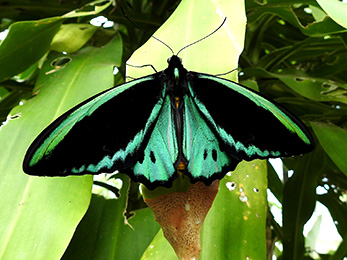
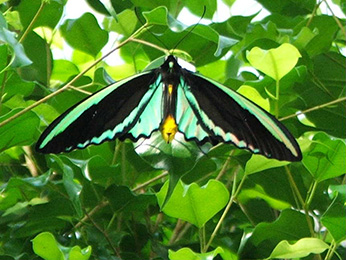
In the fragmented rainforests of eastern Australia, two giants rule the canopy. The Birdwing Butterflies are not merely insects; they are ecological icons. With wingspans reaching up to 18cm, they glide through the rainforest with a slow, powerful beat that resembles a bird in flight—a characteristic that earned them their scientific name.
For the observer, they are a flash of emerald green and velvet black—a “living gemstone.” For the scientist, they are a critical indicator of rainforest health and a masterclass in co-evolution.
A Tale of Two Species
While they share a striking resemblance and a common ancestor, Australia is home to two distinct species of Birdwing, separated by geography and adapted to specific climatic zones.
Both species rely entirely on native Aristolochia vines for their survival, and both face the challenge of habitat loss and invasive weeds.
1. The Tropical Giant: Cairns Birdwing
(Ornithoptera euphorion)
Region: North-Eastern Queensland (Mackay to Cooktown) Habitat: Tropical Rainforest & Coastal Paperbark Swamps
The largest endemic butterfly in Australia. Found in the warmth of the wet tropics, this species is famous for the female’s massive size and the male’s electric green dorsal markings. A true symbol of the north.
2. The Subtropical Survivor: Richmond Birdwing
(Ornithoptera richmondia)
Region: Southern Queensland to Northern New South Wales Habitat: Subtropical Rainforest & Volcanic Soils
The smaller, southern cousin. Once abundant in Brisbane and the Gold Coast hinterland, the Richmond Birdwing is now listed as vulnerable. Its story is one of resilience and community-led recovery through the “Richmond Birdwing Conservation Network.”
Conservation Focus: The Vital Connection
Whether in the tropical north or the subtropical south, the story of the Birdwing is a story of botanical partnership.
Both species are intrinsically linked to the Aristolochia vines. Their future depends on our ability to distinguish friend from foe—planting the correct native host vines and eradicating the deceptive, toxic invasive weeds like Dutchman’s Pipe (Aristolochia elegans).